

The landscape of working in AI has transformed dramatically over the past few years, evolving from a niche field dominated by research scientists to a diverse ecosystem of opportunities accessible to professionals from various backgrounds. As artificial intelligence becomes integrated into business operations across industries, the demand for talent capable of developing, deploying, and managing AI systems has reached unprecedented levels. This shift has created career paths that blend technical expertise with business acumen, opening doors for those who understand both the capabilities of AI technology and its practical applications in real-world scenarios.
The Expanding Universe of AI Careers
Working in AI no longer means exclusively pursuing roles as machine learning engineers or data scientists. The field has diversified to include positions focused on implementation, strategy, ethics, and operations.
Technical Roles in AI Development
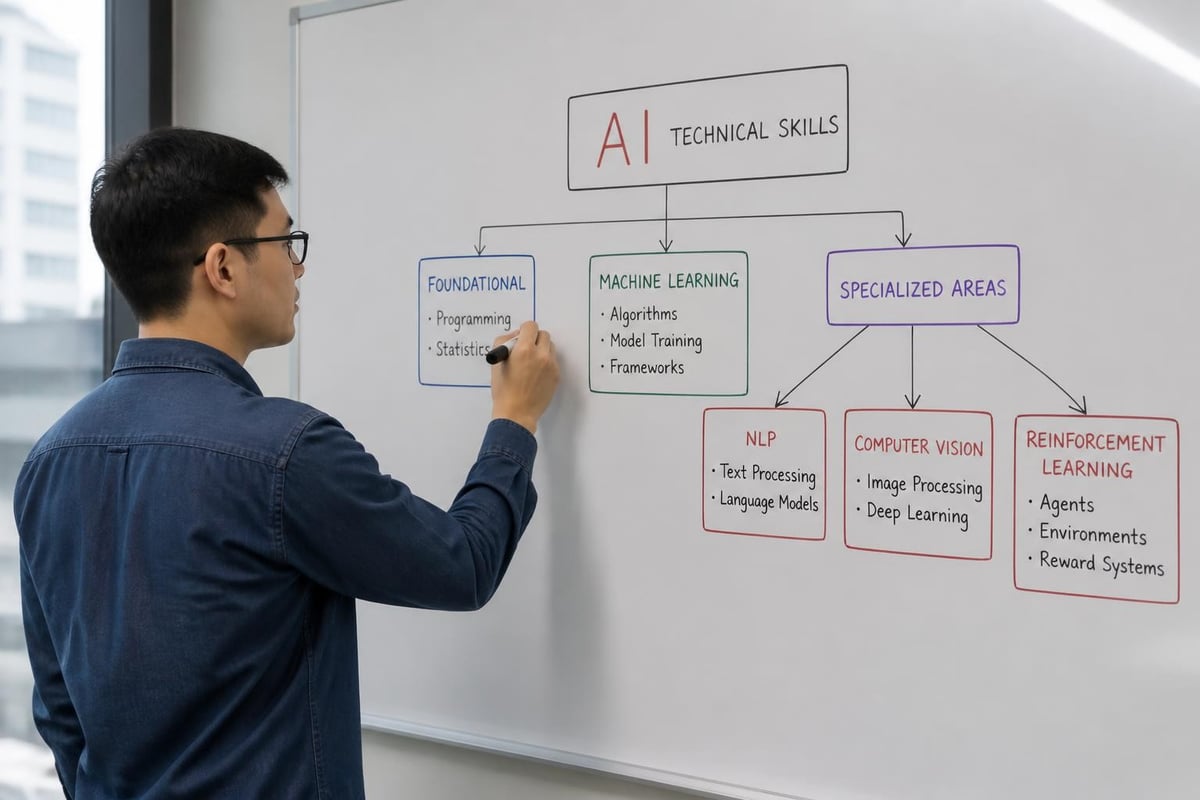
Traditional technical positions remain the foundation of the AI industry. Machine learning engineers design and build algorithms that power AI systems, while data scientists analyze patterns and create predictive models. AI engineers bridge the gap between research and production, ensuring that models perform reliably at scale.
Key technical positions include:
- Machine learning engineers who develop and optimize algorithms
- Natural language processing specialists focusing on conversational AI
- Computer vision engineers working on image and video analysis
- AI research scientists pushing the boundaries of what's possible
- Data engineers building infrastructure for AI systems
According to IEEE Spectrum's guide to landing AI jobs, demand for AI skills extends far beyond tech companies, with industries from healthcare to finance actively recruiting professionals with AI expertise. The average salary for these technical roles ranges from $100,000 to over $200,000 annually, depending on experience and specialization.
Business-Focused AI Positions
The implementation gap between AI development and business value has created entirely new career categories. AI product managers define how AI capabilities translate into user-facing features. AI strategists help organizations identify where AI can create competitive advantages. These roles require understanding both technical constraints and business objectives.
| Role | Primary Focus | Key Skills Required |
|---|---|---|
| AI Product Manager | Feature definition and roadmap | Product strategy, technical literacy, user research |
| AI Implementation Specialist | Deployment and integration | System architecture, change management, training |
| AI Ethics Officer | Responsible AI practices | Policy development, risk assessment, compliance |
| AI Operations Manager | Performance monitoring | Analytics, process optimization, troubleshooting |
Organizations increasingly need professionals who can bridge technical and business domains, making these hybrid roles particularly valuable in 2026.
Skills Required for Working in AI
The competencies needed for working in AI span technical knowledge, domain expertise, and soft skills that facilitate collaboration and innovation.
Technical Foundations
Programming proficiency remains essential, with Python dominating as the primary language for AI development. Understanding frameworks like TensorFlow, PyTorch, and scikit-learn enables professionals to work with existing models and build new solutions. Mathematics, particularly linear algebra, calculus, and statistics, provides the theoretical foundation for understanding how AI algorithms function.
Essential technical skills include:
- Programming languages (Python, R, Java)
- Machine learning frameworks and libraries
- Data manipulation and analysis tools
- Cloud computing platforms (AWS, Azure, Google Cloud)
- Version control and collaborative development practices
For those exploring entry-level AI jobs, starting with foundational courses in programming and statistics creates a pathway to more advanced AI concepts. Many successful AI professionals begin with general software development or data analysis roles before specializing.
Domain Knowledge and Specialization
Working in AI effectively requires understanding the context where AI operates. A healthcare AI specialist needs medical knowledge to design appropriate solutions. An AI professional in e-commerce must understand customer behavior, inventory management, and conversion optimization. This domain expertise often proves as valuable as technical skills.
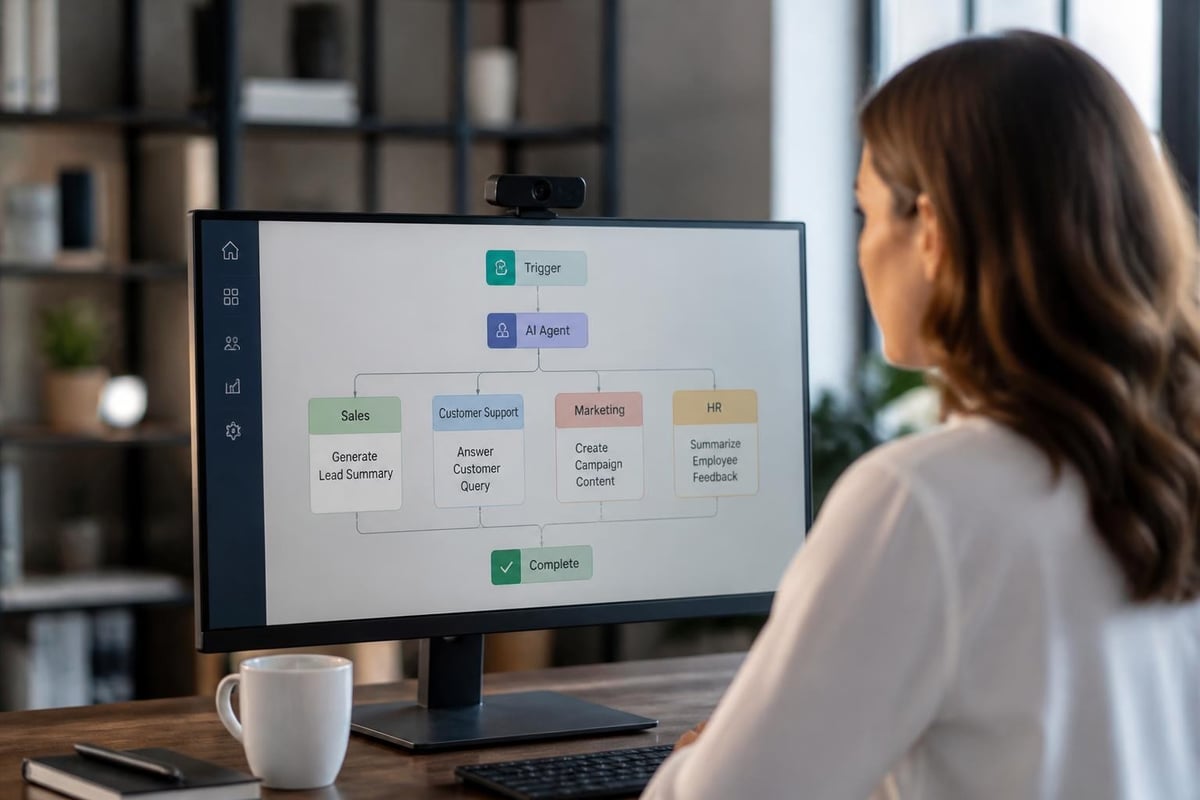
The rise of platforms that enable AI agents to handle business operations demonstrates how domain knowledge shapes AI implementation. Sales AI requires understanding sales processes, while support AI needs knowledge of customer service workflows and escalation protocols.
Domain specialization creates competitive advantages because it's easier for a domain expert to learn AI than for an AI expert to master complex business domains. This reality has opened working in AI to professionals from diverse backgrounds who bring valuable contextual knowledge.
The Rise of No-Code AI Platforms
The democratization of AI through no-code and low-code platforms represents one of the most significant trends in working in AI today. These tools enable business professionals without programming backgrounds to deploy AI solutions, fundamentally changing who can participate in AI development.
Accessibility and Speed
No-code AI platforms reduce the time from concept to deployment from months to days or even hours. Business analysts can build chatbots, automate workflows, and create predictive models without writing code. This accessibility shifts the bottleneck from technical implementation to strategic thinking about where AI creates value.
Organizations using platforms like AI Textura deploy AI agents for sales, support, marketing, and HR without maintaining technical teams or server infrastructure. This approach allows smaller businesses to compete with larger enterprises in AI adoption.
The impact extends beyond cost savings. When business users directly configure AI systems, they align solutions more closely with actual needs, reducing the translation gap between requirements and implementation.
New Career Opportunities in AI Operations
The proliferation of AI platforms creates demand for professionals who excel at configuring, managing, and optimizing AI systems rather than building them from scratch. These "AI operators" understand business processes deeply and know how to leverage AI tools effectively.
Emerging operational roles include:
- AI workflow designer mapping business processes to AI capabilities
- Conversational AI trainer developing dialogue flows and responses
- AI performance analyst monitoring metrics and optimizing outcomes
- Integration specialist connecting AI systems with existing software
- AI change manager facilitating adoption across organizations
These positions offer remote work opportunities, as much of the work involves digital configuration and analysis that can be performed from anywhere.
Industry Applications and Opportunities
Working in AI varies significantly across industries, each presenting unique challenges and opportunities. Understanding these sector-specific applications helps professionals target their career development effectively.
Hospitality and Customer Service
The hospitality industry has embraced AI for reservation management, customer inquiries, and personalized recommendations. AI agents handle booking modifications, answer frequently asked questions, and provide multilingual support. For professionals working in AI within this sector, understanding guest experience and service standards proves crucial.
Hotels and accommodation providers benefit from AI systems that operate 24/7 across time zones, managing reservations and responding to guest needs in over 90 languages. This application demonstrates how working in AI creates value through availability and scalability rather than replacing human service entirely.
E-commerce and Retail
Online retail leverages AI for product recommendations, inventory optimization, dynamic pricing, and customer support. Working in AI for e-commerce requires understanding conversion funnels, customer lifetime value, and the balance between automation and personalization.
Recent data from Gallup polling on AI adoption shows significant increases in AI usage across American workplaces, with retail among the leading sectors. AI-powered chat systems handle product inquiries, track orders, and process returns, freeing human staff for complex customer issues.
Professional Services and White-Collar Work
Time Magazine's analysis of AI's impact on white-collar work highlights how AI transforms knowledge work across legal, financial, consulting, and administrative functions. Document analysis, contract review, financial modeling, and research tasks increasingly incorporate AI assistance.
Working in AI within professional services often focuses on augmentation rather than replacement. AI handles repetitive analysis while professionals apply judgment to complex situations. This partnership model shapes how organizations structure teams and define roles.
| Industry | Primary AI Applications | Key Success Metrics |
|---|---|---|
| Hospitality | Booking, guest support, recommendations | Response time, booking conversion, satisfaction scores |
| E-commerce | Product discovery, support, fraud detection | Conversion rate, average order value, support resolution |
| Healthcare | Diagnosis support, scheduling, patient communication | Diagnostic accuracy, appointment efficiency, patient outcomes |
| Finance | Risk assessment, fraud detection, customer service | Risk identification, false positive rate, customer retention |
Training and Career Development
Building a career working in AI requires continuous learning as the field evolves rapidly. Both formal education and self-directed learning play important roles in career development.
Educational Pathways
Traditional computer science degrees provide strong foundations, but many successful AI professionals come from mathematics, physics, engineering, or even humanities backgrounds. Master's programs in AI and machine learning offer specialized training, though they're not always necessary for entry-level positions.
Platforms like edX offer comprehensive AI career guidance, including information on top jobs, salary expectations, and essential skills. Online courses and bootcamps provide flexible alternatives to formal degrees, particularly for career changers.
Effective learning strategies include:
- Building a strong foundation in programming and mathematics
- Completing hands-on projects that demonstrate practical skills
- Participating in AI competitions and open-source projects
- Specializing in specific applications or industries
- Staying current with research papers and industry developments
On-the-Job Learning and Advancement
Many AI skills are best learned through practical application. Starting in adjacent roles like data analysis, software development, or business intelligence provides pathways into AI positions. Organizations increasingly value demonstrated ability over credentials alone.
Anthropic's innovative Claude Corps fellowship program paying $85,000 annually to train individuals in AI signals a broader trend of employers investing in developing AI talent internally. This approach recognizes that effective working in AI requires combining technical skills with organizational knowledge.

The Human Element in AI Work
Despite automation's growth, working in AI fundamentally involves human judgment, creativity, and ethical reasoning. The most successful AI implementations combine machine efficiency with human insight.
Ethical Considerations and Responsible AI
As AI systems make consequential decisions affecting employment, credit, healthcare, and justice, professionals working in AI must consider ethical implications. Bias in training data can perpetuate discrimination. Lack of transparency can undermine trust. Privacy concerns arise when AI processes personal information.
Organizations need professionals who understand these challenges and can implement responsible AI practices. This includes diverse teams building AI systems, rigorous testing for bias, clear explanations of AI decisions, and human oversight of automated processes.
Collaboration Between Humans and AI
The future of working in AI involves partnership rather than replacement. AI excels at processing large datasets, identifying patterns, and handling repetitive tasks. Humans excel at contextual understanding, creative problem-solving, and navigating ambiguity.
Effective AI implementations recognize these complementary strengths. Customer service AI handles routine inquiries while escalating complex issues to human agents. Sales AI qualifies leads and schedules meetings while humans build relationships and close deals. This division of labor enhances productivity without sacrificing quality.
Future Trends Shaping AI Careers
The trajectory of working in AI points toward increasing accessibility, specialization, and integration with business processes. Understanding these trends helps professionals position themselves for long-term success.
Democratization and Accessibility
As AI tools become more user-friendly, the barrier to entry continues lowering. Professionals across functions will incorporate AI into their work, much as spreadsheets became universal business tools. This trend creates opportunities for those who can identify AI applications and implement solutions rather than building models from scratch.
Platforms that enable deployment without technical infrastructure make working in AI accessible to smaller organizations and non-technical teams. Comparing traditional virtual assistants with AI agents illustrates how automation capabilities have expanded beyond simple scripting to intelligent decision-making.
Specialization and Depth
As AI matures, generalist knowledge becomes less valuable relative to specialized expertise. Professionals who deeply understand specific AI applications, industries, or technical challenges command premium compensation. This mirrors patterns in other maturing technologies where early generalists give way to focused specialists.
The breadth of AI integration possibilities across communication channels, CRM systems, and business tools creates numerous niches for specialization. Experts in particular integration patterns or industry applications develop valuable, defensible expertise.
Augmentation Over Replacement
While fears of AI eliminating jobs persist, the reality emerging in 2026 shows AI augmenting human capabilities more than replacing workers. New roles emerge around AI management, strategy, and oversight. Working in AI increasingly means working with AI as a collaborative tool.
Organizations succeeding with AI focus on redefining roles to leverage both human and machine strengths. This approach requires change management skills, empathy, and communication abilities alongside technical knowledge.
Getting Started in AI Careers
For those considering working in AI, multiple entry points exist depending on background and interests. The key is identifying a starting point aligned with current skills while building toward desired expertise.
For Technical Professionals
Software developers and data professionals can transition into AI roles by acquiring machine learning skills through online courses and practical projects. Starting with supervised learning problems using existing datasets builds foundational understanding. Contributing to open-source AI projects demonstrates capability to potential employers.
Resources from TechTarget on becoming an AI engineer provide structured guidance on required skills and typical career progression. Building a portfolio of projects showcasing different AI techniques creates tangible evidence of expertise.
For Business Professionals
Domain experts can enter AI careers by learning to configure and manage AI systems relevant to their industries. Understanding how AI platforms work, what they can accomplish, and their limitations enables effective implementation without deep technical knowledge.
Business professionals working in AI often serve as translators between technical teams and stakeholders, ensuring solutions address actual business needs. This role requires curiosity about technology combined with strong communication skills and business judgment.
Building Your First AI Project
Practical experience proves more valuable than theoretical knowledge alone. Identifying a real problem and building an AI solution, even a simple one, teaches lessons no course can provide. This might involve creating a chatbot for a specific use case, building a recommendation system, or automating a repetitive task.
Steps for a first AI project:
- Identify a specific problem with clear success criteria
- Research existing solutions and approaches
- Start with the simplest viable implementation
- Test thoroughly with real users or data
- Iterate based on feedback and results
- Document the process and learnings
These projects create portfolio pieces demonstrating practical skills and problem-solving ability, often proving more impressive to employers than credentials alone.
Compensation and Market Demand
Working in AI generally commands premium compensation compared to similar roles in other technology areas. Market demand significantly exceeds supply across most AI specializations, creating favorable conditions for job seekers.
Salaries vary by role, location, and experience level. Entry-level positions typically start between $70,000 and $100,000, while experienced professionals often earn $150,000 to $300,000 or more. Specialized skills in areas like natural language processing, computer vision, or reinforcement learning command particular premiums.
Remote work opportunities have expanded dramatically, allowing professionals to access high-paying positions regardless of geographic location. Many organizations embrace distributed teams for AI work, recognizing that talent pools are global.
The diversity of AI career paths means opportunities exist at various compensation levels. Not everyone working in AI earns Silicon Valley salaries, but most positions offer competitive pay reflecting the value these skills create.
Working in AI encompasses far more than building algorithms; it requires understanding business needs, implementing practical solutions, and navigating ethical considerations while driving meaningful outcomes. As AI becomes fundamental to business operations across industries, professionals who combine technical knowledge with domain expertise and strategic thinking will find abundant opportunities. AI Textura makes this transformation accessible by providing platforms where businesses deploy AI agents for sales, support, marketing, and HR without coding expertise or infrastructure management, demonstrating how AI capabilities are becoming available to organizations of all sizes ready to embrace intelligent automation.