

The digital landscape has fundamentally transformed with the emergence of web site ai technologies that power modern business operations. Rather than serving as simple information portals, today's websites function as intelligent platforms where AI agents actively manage customer interactions, process transactions, and coordinate complex business workflows. This shift represents a fundamental change in how organizations approach their online presence, moving from static web pages to dynamic, autonomous systems that operate around the clock in multiple languages and across various business functions.
Understanding Web Site AI Technology
Web site ai encompasses far more than chatbots or simple automation scripts. Modern AI-powered websites leverage sophisticated machine learning models and natural language processing to understand context, make decisions, and execute actions that traditionally required human intervention. These systems can interpret customer inquiries, process bookings, update databases, and even handle complex negotiations without requiring constant oversight.
The architecture behind web site ai typically combines several key components working in harmony. Natural language understanding allows the system to comprehend user intent across different languages and communication styles. Decision-making engines evaluate multiple factors to determine appropriate responses or actions. Integration layers connect with existing business systems like CRM platforms, payment processors, and inventory management tools.

Key Capabilities That Define Modern Web Site AI
Modern web site ai platforms deliver capabilities that extend well beyond basic automation. Autonomous transaction processing enables AI agents to complete purchases, schedule appointments, and manage bookings without human approval for routine scenarios. Contextual memory allows these systems to maintain conversation history and customer preferences across multiple interactions, creating personalized experiences.
Multi-system orchestration represents another critical capability where AI agents coordinate actions across multiple platforms. For instance, when processing a hotel booking, the system might simultaneously check availability, process payment, update the property management system, send confirmation emails, and add follow-up tasks to a CRM database.
According to recent analysis on AI in web development, these capabilities are becoming standard expectations rather than premium features as businesses recognize the competitive advantage they provide.
Business Operations Transformed by Web Site AI
The impact of web site ai extends across virtually every business function. Organizations implementing these technologies report significant improvements in efficiency, customer satisfaction, and revenue generation. Understanding how different departments benefit from AI integration helps businesses prioritize implementation strategies.
Sales Automation and Revenue Generation
Sales teams benefit tremendously from web site ai that handles initial prospect engagement, qualification, and even closing transactions for standardized offerings. AI agents can engage website visitors in real-time, answer product questions, provide personalized recommendations based on browsing behavior, and guide customers through purchase processes.
Lead qualification becomes dramatically more efficient when AI agents can assess prospect fit through conversational interactions. The system gathers necessary information, scores leads based on predefined criteria, and routes qualified prospects to appropriate sales representatives. This process happens instantly, ensuring no opportunity falls through cracks due to delayed response times.
For e-commerce businesses, web site ai manages the entire customer journey from discovery through post-purchase support. The technology handles product recommendations, answers technical questions, processes transactions, and coordinates fulfillment-all while learning from each interaction to improve future performance.
Customer Support Excellence
Customer support represents one of the most impactful applications of web site ai. Support agents powered by AI can simultaneously manage thousands of customer conversations across multiple channels, providing instant responses regardless of time zone or business hours. The technology resolves routine inquiries automatically while seamlessly escalating complex issues to human agents when necessary.
| Support Metric | Traditional Website | Web Site AI Implementation |
|---|---|---|
| Average Response Time | 4-8 hours | Instant |
| Available Hours | Business hours only | 24/7/365 |
| Concurrent Conversations | 3-5 per agent | Unlimited |
| Language Support | 1-2 languages | 90+ languages |
| First Contact Resolution | 45-60% | 75-85% |
The data clearly demonstrates how web site ai transforms support operations. Businesses implementing these solutions report significant reductions in support costs while simultaneously improving customer satisfaction scores. The technology particularly excels at handling high-volume, routine inquiries that consume substantial human agent time.
Marketing and Customer Engagement
Marketing departments leverage web site ai to create personalized customer journeys at scale. AI agents analyze visitor behavior, segment audiences dynamically, and deliver targeted messaging that adapts based on real-time interactions. This level of personalization was previously impossible without massive marketing teams and complex automation workflows.
Campaign optimization happens continuously as web site ai learns which messages, offers, and engagement strategies produce the best results for different customer segments. The system automatically adjusts approaches based on performance data, eliminating the lengthy testing cycles traditional marketing requires.
As discussed in comprehensive guides on AI in web development, marketing automation through AI has evolved from simple email sequences to sophisticated, multi-channel orchestration that responds to customer signals across touchpoints.
Implementation Strategies for Web Site AI
Successfully deploying web site ai requires careful planning and strategic execution. Organizations that achieve the best results typically follow structured implementation approaches rather than attempting comprehensive overnight transformations.
Starting with High-Impact Use Cases
The most effective implementation strategy focuses on high-impact, well-defined use cases that deliver measurable results quickly. Booking and scheduling represents an ideal starting point for many businesses because the workflow is clearly defined, success metrics are straightforward, and the value proposition is immediately apparent to both customers and staff.
For hospitality businesses, implementing web site ai for room reservations, dining bookings, and service requests creates immediate value. Guests appreciate instant confirmation and 24/7 availability, while staff members gain time previously spent on routine booking management. Platforms like AI Textura specialize in these scenarios, offering pre-configured agents that handle these operations without requiring technical expertise.
Customer inquiry management serves as another excellent starting point. AI agents can handle frequently asked questions, provide product information, and collect customer details for follow-up. This application delivers quick wins while building organizational confidence in the technology.
Integration with Existing Systems
Web site ai delivers maximum value when integrated seamlessly with existing business systems. The technology should function as an extension of current operations rather than a disconnected add-on. Successful integration requires mapping how AI agents will interact with CRM platforms, e-commerce systems, payment processors, and other critical infrastructure.
Modern web site ai platforms offer pre-built integrations with popular business tools, significantly reducing implementation complexity. These connectors enable AI agents to read from and write to existing databases, trigger workflows in other systems, and maintain data synchronization across platforms.
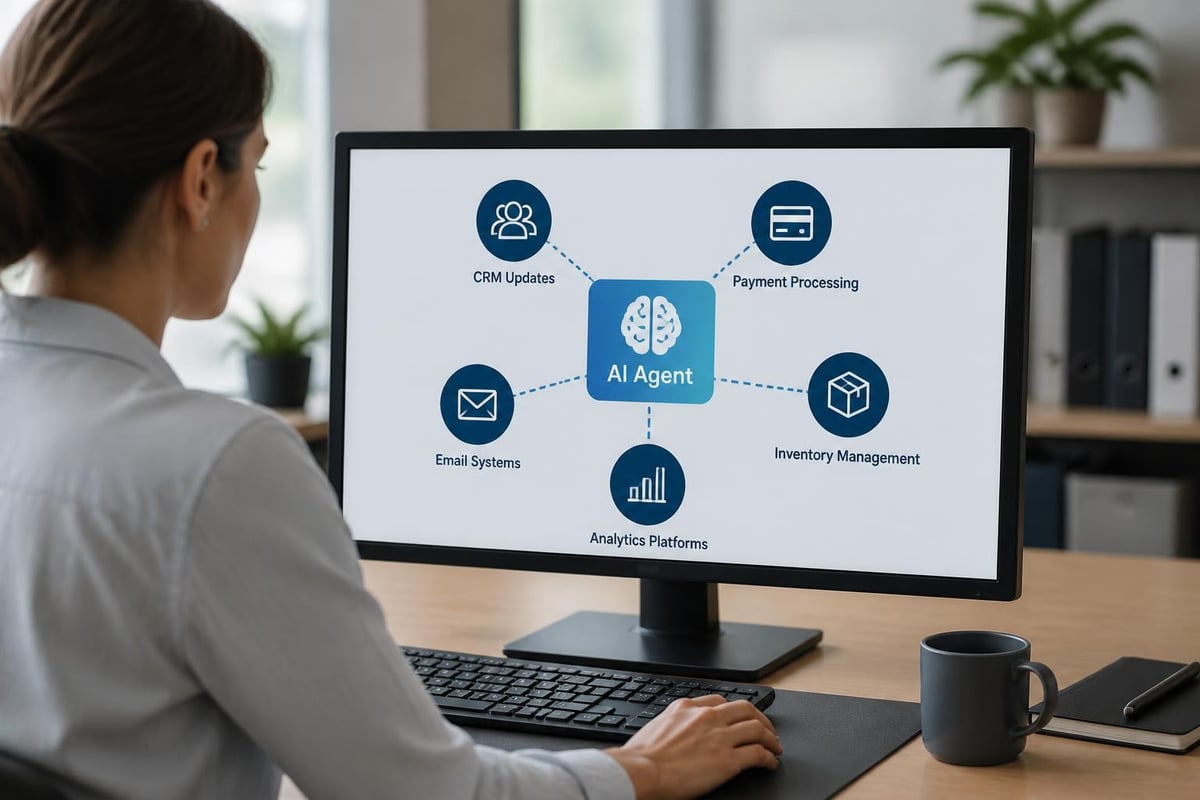
Organizations should prioritize integrations that enable complete workflows rather than partial automation. For example, an AI agent that can check availability, process payment, update the booking system, and send confirmation emails delivers far more value than one that only answers questions about availability.
No-Code vs. Custom Development
The web site ai landscape offers options ranging from no-code platforms to fully custom development. Each approach serves different organizational needs and capabilities. No-code platforms enable rapid deployment without technical resources, making them ideal for small to medium businesses or organizations testing AI capabilities for the first time.
These platforms provide pre-built agents, visual configuration interfaces, and managed hosting. Users define agent behavior through conversational interfaces or simple form-based configurations rather than writing code. For businesses exploring options, comparing different AI workforce solutions helps identify platforms aligned with specific requirements.
Custom development offers maximum flexibility but requires significant technical expertise and ongoing maintenance. Organizations with unique workflows, complex integration requirements, or highly specialized industries may benefit from custom solutions. However, the time and cost investment typically makes this approach suitable only for large enterprises with dedicated development teams.
According to insights on AI tools for web development, the trend is moving toward hybrid approaches where no-code platforms handle standard functionality while allowing custom code for unique requirements.
Advanced Capabilities Reshaping Business Operations
As web site ai matures, advanced capabilities are emerging that fundamentally change how businesses operate. These innovations extend beyond automation to enable entirely new business models and customer experiences.
Multilingual Global Operations
Operating globally traditionally required hiring staff fluent in each target market's language. Web site ai eliminates this constraint by enabling truly multilingual operations where a single AI agent can converse fluently in over 90 languages. The technology doesn't simply translate text-it understands cultural context, local business practices, and regional preferences.
This capability proves particularly valuable for hospitality businesses serving international clientele. A hotel in New York can provide seamless service to guests from Japan, Brazil, Germany, and India without maintaining multilingual staff around the clock. The AI agent adapts its communication style, understands cultural nuances, and even adjusts recommendations based on regional preferences.
Language detection happens automatically as customers initiate conversations. The web site ai identifies the language being used and responds appropriately, switching languages mid-conversation if the customer prefers. This seamless experience creates the impression of a globally staffed operation while maintaining operational efficiency.
Predictive Actions and Proactive Engagement
The most advanced web site ai systems don't wait for customer inquiries-they anticipate needs and take proactive actions. By analyzing patterns in customer behavior, purchase history, and contextual signals, these systems identify opportunities for engagement before customers explicitly request assistance.
For e-commerce operations, this might mean reaching out to customers who abandoned shopping carts with personalized offers, notifying customers when wished-for items come back in stock, or suggesting complementary products based on recent purchases. The AI agent initiates these interactions at optimal times, increasing conversion rates while maintaining a helpful rather than intrusive tone.
Operational predictions extend beyond customer-facing interactions. Web site ai can forecast inventory needs, identify potential service disruptions, and alert staff to unusual patterns that might indicate problems. This predictive capability transforms the technology from a reactive service tool into a proactive business intelligence asset.
Continuous Learning and Improvement
Unlike static rule-based systems, modern web site ai continuously learns from interactions and improves performance over time. Each customer conversation, transaction, and outcome feeds machine learning models that refine the agent's capabilities. This learning happens automatically without requiring manual updates or reprogramming.
The improvement cycle includes several key mechanisms:
- Response optimization where the system tests different approaches and adopts strategies that produce better outcomes
- Intent recognition enhancement as the AI learns to understand new ways customers phrase questions or requests
- Context awareness expansion where the system builds knowledge about products, services, and business operations
- Error correction through identification and resolution of misunderstandings or failed transactions
Organizations benefit from this continuous improvement without investing in ongoing development. The web site ai becomes more capable and valuable as it accumulates experience, creating compounding returns on the initial implementation investment.
Industry-Specific Applications
Different industries leverage web site ai in unique ways that address sector-specific challenges and opportunities. Understanding these applications helps businesses identify relevant use cases and implementation strategies.
Hospitality and Travel
The hospitality sector has embraced web site ai extensively for managing reservations, guest services, and property operations. Hotels use AI agents to handle room bookings, process special requests, coordinate concierge services, and manage check-in/check-out procedures. The technology operates across multiple properties, maintaining brand consistency while adapting to property-specific features and policies.
Revenue management benefits significantly from AI integration. The system can dynamically adjust pricing based on demand patterns, competitor rates, and booking trends. It manages promotional offers, applies discount codes appropriately, and even negotiates rates for group bookings within predefined parameters.
Guest communication extends throughout the entire journey. Pre-arrival messages confirm reservations and gather preferences. During stays, the AI agent handles service requests, provides local recommendations, and resolves issues. Post-departure follow-up collects feedback and encourages future bookings.
E-commerce and Retail
E-commerce businesses deploy web site ai to manage the entire customer lifecycle from initial discovery through repeat purchases. AI agents function as virtual sales associates, helping customers find products, comparing options, answering questions, and completing transactions. The technology handles product recommendations with sophistication that matches or exceeds human sales staff.
Inventory coordination represents a critical e-commerce application. Web site ai monitors stock levels, updates product availability in real-time, and manages backorder processes. When items are out of stock, the agent suggests alternatives, offers notifications when products return, and manages customer expectations about delivery timelines.
For insights on how AI agents compare to traditional staffing models, businesses can evaluate the economic and operational advantages of these implementations.
Professional Services
Professional service firms use web site ai to streamline client intake, schedule consultations, and manage service delivery. Law firms, accounting practices, consulting agencies, and medical offices deploy AI agents to handle appointment scheduling, collect client information, answer routine questions about services, and coordinate billing.
The technology proves particularly valuable for managing high volumes of initial inquiries. Rather than requiring administrative staff to field every call or email, the web site ai qualifies leads, gathers necessary information, and schedules appropriate follow-up. This approach ensures prospects receive immediate attention while optimizing staff time for higher-value activities.

Measuring Web Site AI Success
Implementing web site ai requires establishing clear metrics to evaluate performance and justify ongoing investment. Organizations should track both operational efficiency improvements and customer experience enhancements.
Operational Metrics
Key operational metrics provide insight into how web site ai affects business efficiency and cost structure. Response time reduction measures how quickly customers receive answers compared to traditional approaches. Organizations typically see response times drop from hours to seconds with AI implementation.
Resolution rate tracks the percentage of customer inquiries fully resolved by the AI agent without human intervention. Higher resolution rates indicate more capable AI agents and translate directly into cost savings through reduced staffing requirements.
| Metric | Definition | Target Range |
|---|---|---|
| First Response Time | Time from inquiry to initial response | < 30 seconds |
| Full Resolution Rate | % of inquiries resolved without escalation | 70-85% |
| Concurrent Conversation Capacity | Simultaneous interactions handled | Unlimited |
| Cost per Interaction | Total cost divided by interactions | 80-90% reduction |
| Uptime Percentage | System availability | > 99.5% |
Transaction completion rate measures how effectively web site ai converts inquiries into completed actions like bookings, purchases, or scheduled appointments. This metric directly ties AI performance to revenue generation.
Customer Experience Indicators
Customer satisfaction metrics reveal how web site ai affects the user experience. Customer Satisfaction Score (CSAT) surveys following AI interactions provide direct feedback on service quality. Organizations implementing AI agents typically maintain or improve satisfaction scores while dramatically reducing costs.
Net Promoter Score (NPS) indicates whether the AI-enhanced experience increases customer loyalty and willingness to recommend the business. The 24/7 availability and instant response times that web site ai enables often drive NPS improvements.
Engagement depth metrics track how thoroughly customers interact with AI agents. Deeper engagement-measured through conversation length, questions asked, and actions completed-indicates that customers find value in the AI-powered experience.
According to research on AI-powered web development, businesses that carefully track these metrics and iteratively improve their AI implementations see continuous performance gains over 12-18 month periods.
Security and Privacy Considerations
Deploying web site ai requires careful attention to security and privacy implications. These systems handle sensitive customer data, process transactions, and access critical business systems-creating potential vulnerabilities if not properly secured.
Data Protection Standards
Web site ai platforms must comply with relevant data protection regulations including GDPR, CCPA, and industry-specific requirements. This includes implementing proper data encryption, maintaining audit trails, and providing mechanisms for customers to access, correct, or delete their information.
Encryption standards should apply both to data in transit and at rest. Communications between customers and AI agents should use industry-standard protocols like TLS 1.3. Stored data requires encryption using current best practices to protect against breaches.
Access controls limit which AI agents can view or modify specific data types. Organizations should implement role-based permissions that mirror those applied to human staff members. An AI agent handling basic inquiries shouldn't access the same systems as one processing financial transactions.
Transaction Security
When web site ai processes payments, bookings, or other financial transactions, additional security measures become critical. PCI DSS compliance applies to any AI agent handling credit card information. The system should tokenize payment data, minimizing exposure of sensitive card details.
Fraud detection capabilities should monitor transactions for suspicious patterns. Web site ai can actually enhance security by identifying anomalous behavior that might indicate fraudulent activity, alerting security teams to potential issues faster than manual monitoring.
Authentication mechanisms verify customer identity when appropriate. For high-value transactions or sensitive operations, the AI agent should require multi-factor authentication or other identity verification before proceeding.
Future Trends in Web Site AI
The web site ai landscape continues evolving rapidly as technology advances and businesses discover new applications. Several emerging trends will shape how organizations leverage these capabilities in coming years.
Voice and Multimodal Interactions
Web site ai is expanding beyond text-based interactions to include voice conversations and visual elements. Customers can speak inquiries rather than typing them, with AI agents processing natural speech and responding conversationally. This evolution makes AI interactions more accessible and natural for many users.
Visual understanding enables AI agents to process images shared by customers. A customer might photograph a product they're interested in, and the web site ai identifies the item, provides information, and facilitates purchase. For support scenarios, customers can share images of problems they're experiencing, and the AI agent troubleshoots based on visual information.
Autonomous Business Decision-Making
Advanced web site ai systems are beginning to make strategic business decisions within defined parameters. Rather than simply executing predetermined workflows, these systems evaluate options, predict outcomes, and choose optimal approaches. This capability extends AI from operational automation into strategic business management.
Dynamic pricing decisions represent one application where AI agents analyze market conditions, competitor behavior, and demand patterns to adjust pricing in real-time. The system operates within boundaries set by business leaders but makes tactical decisions autonomously.
Resource allocation decisions help businesses optimize operations. Web site ai might automatically schedule staff based on predicted customer volume, adjust marketing spend across channels based on performance, or prioritize product development based on customer feedback patterns.
As explored in current AI web development trends, these autonomous capabilities are becoming more sophisticated and accessible to businesses of all sizes throughout 2026.
Ecosystem Integration and Orchestration
Future web site ai will function as central orchestration layers that coordinate across entire business ecosystems. Rather than isolated agents handling specific tasks, businesses will deploy interconnected AI systems that collaborate to manage complex, multi-step processes spanning multiple platforms and business functions.
This orchestration extends to third-party services and partner organizations. An AI agent booking travel might coordinate with airline systems, hotel properties, ground transportation services, and payment processors-managing the entire workflow as a unified experience while technically interacting with dozens of separate systems.
Web site ai has evolved from a futuristic concept to an essential business capability that transforms operations across industries. Organizations implementing these technologies gain competitive advantages through improved efficiency, enhanced customer experiences, and the ability to operate at scale without proportional increases in staffing costs. AI Textura provides a comprehensive platform for businesses ready to deploy AI agents that handle sales, support, marketing, and operational tasks across 90+ languages without requiring coding expertise or server management. By starting with focused use cases and expanding based on results, businesses can progressively transform their operations and unlock the full potential of intelligent, autonomous web site ai.