

The "made with AI" label has become increasingly prominent across digital products, services, and business solutions in 2026. This transparency marker represents more than a trend-it signals a fundamental shift in how businesses approach operations, customer engagement, and scalability. As artificial intelligence becomes deeply integrated into everyday business functions, understanding what "made with AI" means for your organization helps you make informed decisions about adopting these technologies and communicating their use to customers.
Understanding the Made with AI Movement
The "made with AI" designation emerged from a growing need for transparency in an increasingly automated digital landscape. When businesses display this label, they acknowledge that artificial intelligence played a significant role in creating, developing, or operating their product or service.
This transparency serves multiple purposes. Customers gain clarity about what they're interacting with, businesses build trust through honest communication, and innovation becomes visible in ways that highlight competitive advantages. The phrase "made with AI" encompasses everything from content generated by language models to sophisticated AI agents managing entire business workflows.
Different Categories of AI-Made Solutions
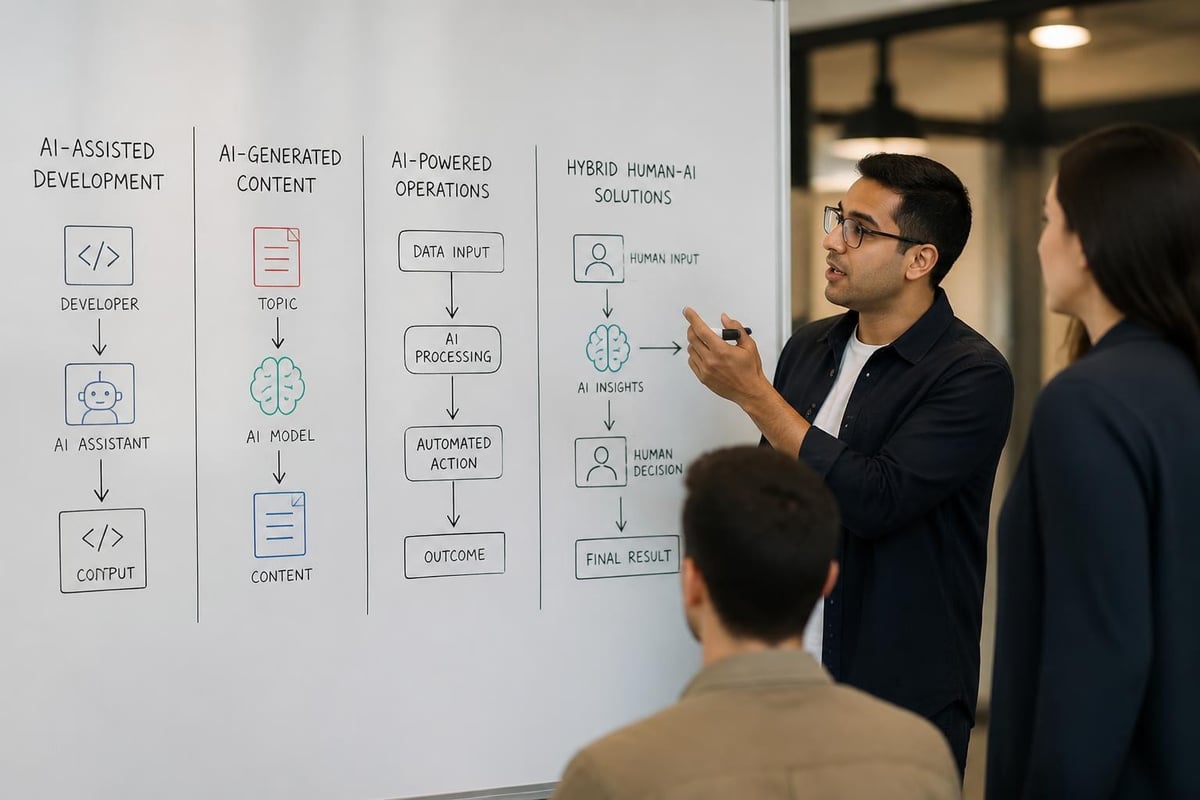
Products and services labeled as made with AI fall into distinct categories, each representing different levels of AI involvement:
- AI-assisted development: Traditional products enhanced with AI tools during creation
- AI-generated content: Articles, images, videos, or code produced primarily by AI systems
- AI-powered operations: Services where AI handles core business functions autonomously
- Hybrid solutions: Human oversight combined with AI execution capabilities
Platforms like Made by Claude showcase diverse examples of products developed using AI, demonstrating how businesses across industries leverage these technologies. The registry highlights practical applications ranging from simple automation tools to complex enterprise solutions.
Why Businesses Choose Made with AI Solutions
Organizations increasingly adopt solutions made with AI because they address fundamental business challenges that traditional approaches struggle to solve efficiently. The decision to implement AI-powered systems stems from practical considerations rather than technological novelty.
Speed and scalability represent primary drivers. AI agents can handle thousands of customer interactions simultaneously across multiple channels without requiring proportional increases in human staff. This capability proves particularly valuable for businesses experiencing rapid growth or seasonal fluctuations in demand.
Cost efficiency extends beyond simple labor savings. When you examine the total cost of ownership, AI solutions eliminate expenses related to hiring, training, office space, benefits, and turnover. Businesses can redirect these resources toward strategic initiatives while maintaining or improving service quality.
Real-World Applications Across Industries
Different sectors implement made with AI solutions to address industry-specific challenges:
| Industry | AI Application | Business Impact |
|---|---|---|
| Hospitality | Automated booking and guest services | 24/7 availability in 90+ languages |
| E-commerce | Intelligent sales agents and support | Increased conversion rates |
| Healthcare | Patient scheduling and information | Reduced administrative burden |
| Finance | Customer service and compliance | Consistent regulatory adherence |
The AI gallery features experiments and prototypes demonstrating how businesses test and refine AI applications before full deployment. These proof-of-concept projects reveal the iterative process behind successful AI implementations.
Businesses also value the consistency that AI provides. Unlike human employees who have varying skill levels and emotional states, AI agents deliver uniform quality across every interaction. This reliability becomes especially critical in customer-facing roles where brand consistency directly impacts customer satisfaction and loyalty.
Implementing AI Agents in Your Operations
The process of integrating AI into business operations has evolved significantly from complex, code-heavy implementations to accessible platforms that non-technical teams can deploy. Understanding this implementation landscape helps businesses make realistic plans for AI adoption.
Modern AI agent platforms eliminate traditional technical barriers. You no longer need in-house developers, server infrastructure, or extensive IT support to deploy sophisticated AI solutions. The focus shifts from technical capability to strategic configuration-defining what you want AI agents to accomplish and how they should interact with customers.
Configuration vs. Programming
Traditional software required extensive programming knowledge. Solutions made with AI today operate differently:
- Define business objectives: Specify what tasks AI agents should handle
- Configure communication channels: Connect AI to existing platforms and tools
- Train on your knowledge base: Upload documents, policies, and product information
- Set operational parameters: Establish working hours, escalation rules, and permissions
- Monitor and refine: Adjust based on performance data and customer feedback
When comparing AI agents versus hiring staff, businesses discover that deployment timelines compress from weeks or months to days. This speed advantage allows rapid testing and iteration, reducing the risk associated with operational changes.
The documentation for channels shows how AI agents integrate with messaging platforms, CRM systems, and other business tools. These integrations enable AI to take real actions-updating customer records, processing bookings, initiating refunds, or escalating complex issues to human team members.

Transparency and Customer Communication
How businesses communicate about AI-made solutions significantly impacts customer acceptance and trust. The decision to display "made with AI" labels involves strategic considerations about brand positioning and customer expectations.
Transparency builds credibility in markets where customers increasingly value honesty about business practices. When you openly acknowledge AI involvement, you prevent negative reactions that might occur if customers discover AI usage through their own investigation. Proactive disclosure demonstrates confidence in your technology choices.
However, transparency doesn't mean overwhelming customers with technical details. Effective communication about AI focuses on benefits and capabilities rather than underlying technology. Customers care more about response speed, accuracy, and problem resolution than whether a human or AI agent provides assistance.
Best Practices for AI Disclosure
Organizations successfully using AI-made solutions follow these communication guidelines:
- Lead with value: Emphasize how AI improves customer experience
- Be specific: Explain what AI handles and when humans intervene
- Provide options: Offer human escalation for customers who prefer it
- Highlight benefits: Mention 24/7 availability and multilingual support
- Show results: Share performance metrics and customer satisfaction data
The community showcase at Wowww.ai demonstrates how creators and businesses present AI-made projects, with voting and curation highlighting approaches that resonate with audiences. These examples provide valuable insights into effective positioning strategies.
Different customer segments respond differently to AI involvement. Technical audiences often appreciate AI implementation and may specifically seek AI-powered solutions for their advanced capabilities. General consumers focus more on outcomes-whether their problems get solved efficiently regardless of who or what provides assistance.
The Competitive Advantage of AI-Made Operations
Businesses that successfully implement AI-made solutions gain multiple competitive advantages that compound over time. These benefits extend beyond operational efficiency to strategic positioning and market differentiation.
Market responsiveness improves dramatically when AI handles routine operations. Your team can focus on strategic initiatives, product development, and complex problem-solving while AI manages predictable workflows. This division of labor accelerates innovation cycles and shortens time-to-market for new offerings.
The ability to operate across 90+ languages without hiring multilingual staff opens international markets that might otherwise remain inaccessible to small and medium businesses. AI agents communicate fluently in customer-preferred languages, eliminating language barriers as a growth constraint.
Measuring AI Impact on Business Metrics
Tracking the right metrics helps justify AI investments and identify optimization opportunities:
| Metric Category | Key Indicators | Typical Improvement |
|---|---|---|
| Response Time | First response, resolution time | 70-90% reduction |
| Availability | Hours of operation, coverage | 24/7 vs. business hours |
| Cost per Interaction | Total cost divided by interactions | 60-80% decrease |
| Customer Satisfaction | CSAT scores, NPS | 15-25% increase |
| Conversion Rate | Sales closed, bookings completed | 20-40% improvement |
Projects featured on Dropday.ai track the evolution from prototype to production, illustrating how AI applications mature and deliver increasing value as they're refined. This trajectory shows that initial implementations represent starting points rather than final states.
Businesses also gain data advantages through AI implementation. Every interaction generates insights about customer needs, pain points, and behavior patterns. AI systems analyze these patterns to identify opportunities for service improvements, product development, and personalized customer experiences that drive loyalty and revenue growth.

Choosing the Right AI Solution for Your Business
The expanding marketplace of AI solutions made with AI creates both opportunities and challenges for businesses evaluating options. Selection criteria should align with specific business needs rather than chasing technological trends or feature lists.
Integration capability ranks among the most critical factors. Your AI solution must connect seamlessly with existing systems-CRM platforms, payment processors, scheduling tools, and communication channels. Solutions requiring extensive custom development or system replacements often fail due to implementation complexity and cost overruns.
Understanding the difference between AI platforms like ChatGPT and purpose-built business AI agents helps clarify requirements. General-purpose AI tools require significant configuration and lack built-in business logic, while specialized platforms offer pre-configured workflows for common business scenarios.
Evaluation Framework for AI Platforms
When assessing AI solutions, consider these dimensions:
- Deployment speed: How quickly can you launch functional AI agents?
- Technical requirements: What expertise does setup and maintenance demand?
- Action capability: Can AI complete transactions or only provide information?
- Scalability: How does pricing and performance scale with growth?
- Support and training: What resources help you maximize AI effectiveness?
The comparison resources available for AI workforce platforms highlight feature differences and use case alignment. These comparisons reveal that superficially similar solutions often diverge significantly in practical application.
Security and compliance represent non-negotiable requirements for businesses in regulated industries or handling sensitive customer data. Your AI solution must meet industry standards for data protection, provide audit trails for transactions, and support compliance with regional regulations affecting your markets.
Industry-Specific AI Applications
Different industries benefit from AI-made solutions in unique ways, with specific use cases delivering outsized value based on sector characteristics and customer expectations.
Hospitality businesses leverage AI for guest communication, booking management, and service requests. Hotels using AI agents handle reservation modifications, answer facility questions, and process special requests without human intervention. This automation proves especially valuable for properties serving international guests requiring multilingual support.
E-commerce operations deploy AI for product recommendations, order tracking, return processing, and customer service. AI agents guide customers through purchase decisions, resolve shipping issues, and manage the post-purchase experience that drives repeat business and positive reviews.
Vertical-Specific Capabilities
Industry-focused AI solutions incorporate domain knowledge that generic platforms lack:
- Healthcare: Appointment scheduling, insurance verification, patient education
- Real estate: Property inquiries, showing coordination, application processing
- Professional services: Intake forms, scheduling, document collection
- Retail: Inventory checks, store locator, loyalty program management
Exploring projects on Made with Replit reveals how creators build specialized applications for niche industries, demonstrating that AI customization addresses specific market needs rather than offering one-size-fits-all solutions. The VibeDock collection similarly showcases vertical applications that solve targeted problems.
Financial services firms implement AI for account inquiries, fraud detection, and compliance monitoring. The accuracy and consistency requirements in finance demand AI systems that maintain detailed interaction logs and provide explainable decision-making processes.
The Future of Made with AI Business Operations
The trajectory of AI-made business solutions points toward increasing sophistication and broader adoption across all business sizes and industries. Understanding these trends helps businesses plan strategic technology investments and maintain competitive positioning.
Autonomous decision-making capabilities continue expanding. Current AI agents execute predefined workflows and escalate exceptions. Future iterations will handle increasingly complex decisions independently, using contextual understanding and historical data to resolve novel situations without human intervention.
The integration depth between AI agents and business systems will deepen. Rather than AI sitting as a layer atop existing tools, businesses will deploy AI-native operations where intelligence is embedded throughout processes. This evolution transforms AI from an add-on to the foundational architecture of business operations.
Emerging Capabilities on the Horizon
Several developments will reshape how businesses use AI-made solutions:
- Predictive engagement: AI initiating customer contact based on behavior signals
- Cross-functional coordination: AI agents collaborating across departments
- Emotional intelligence: Improved recognition and response to customer sentiment
- Proactive problem-solving: Identifying and addressing issues before customer complaints
- Continuous self-improvement: AI systems optimizing their own performance
Personal portfolios like Hacka.ai and Mike's App Lab demonstrate experimental approaches that preview future mainstream capabilities. Individual creators often pioneer techniques that eventually become standard features in enterprise platforms.
The regulatory landscape surrounding AI transparency will evolve, potentially making "made with AI" disclosures mandatory in certain contexts. Businesses adopting transparent practices now position themselves advantageously for future compliance requirements while building customer trust in the present.
The "made with AI" movement represents a fundamental shift in how businesses operate, compete, and serve customers. Transparency about AI usage builds trust, while the operational capabilities of modern AI agents deliver measurable improvements in efficiency, scalability, and customer satisfaction. AI Textura provides a complete platform for businesses ready to harness these advantages-deploying AI agents that handle sales, support, marketing, and HR operations without coding or server management, operating across 90+ languages to serve customers anywhere in the world.