

The business of AI has evolved from experimental technology into a fundamental economic driver reshaping how companies generate revenue, allocate resources, and compete in global markets. Organizations across industries are discovering that artificial intelligence isn't just about automation but about fundamentally reimagining business models, customer relationships, and value creation. As we navigate 2026, the question is no longer whether to adopt AI, but how to strategically deploy it for maximum business impact.
The Economic Transformation of AI in Business
The financial stakes surrounding the business of AI have reached unprecedented levels. According to research, only 20 percent of companies are capturing three-quarters of AI's financial gains, creating a widening gap between AI leaders and laggards.
This concentration of benefits reveals a critical truth: successful AI implementation requires more than technology adoption. It demands strategic alignment between AI capabilities and core business objectives.
Revenue Generation Through AI Agents
Modern AI agents have transcended simple chatbots to become revenue-generating assets. These systems actively participate in sales processes, qualify leads, handle transactions, and manage customer relationships across multiple touchpoints.
Key revenue capabilities include:
- Direct sales conversion through conversational commerce
- Upselling and cross-selling based on behavioral analysis
- Personalized product recommendations at scale
- Automated booking and reservation management
- Dynamic pricing optimization
The transformation is particularly evident in industries like hospitality and e-commerce, where AI agents handle complex transactions in over 90 languages, breaking down geographical and linguistic barriers to revenue growth.

Strategic Value Creation in the Business of AI
The business of AI extends beyond cost reduction to fundamental value creation. Companies are discovering that AI technologies like machine learning and natural language processing are transforming business operations in ways that create competitive moats.
Strategic value manifests in three critical dimensions:
Operational Excellence
AI agents manage routine business operations without human intervention, freeing teams to focus on strategic initiatives. This includes CRM updates, scheduling, customer support resolution, and data entry across systems.
| Business Function | Traditional Approach | AI-Driven Approach | Value Impact |
|---|---|---|---|
| Customer Support | Human agents, 8-hour shifts | 24/7 AI agents, instant response | 70% cost reduction, 3x availability |
| Lead Qualification | Manual review, delayed follow-up | Real-time scoring, immediate engagement | 5x faster qualification, 40% higher conversion |
| HR Onboarding | Multi-day manual process | Automated workflows, guided experience | 80% time savings, consistent quality |
Customer Experience Enhancement
The business of AI thrives on personalization at scale. AI agents analyze customer data, preferences, and behavior patterns to deliver tailored experiences that would be impossible for human teams to replicate across thousands of interactions.
Businesses implementing AI-driven customer experiences report measurable improvements in satisfaction scores, retention rates, and lifetime value. The key lies in deploying agents that understand context and can take meaningful actions, not just provide information.
Strategic Decision Intelligence
Modern AI systems contribute to strategic planning by processing vast amounts of market data, customer feedback, and operational metrics. This intelligence informs product development, market expansion, and resource allocation decisions with greater precision than traditional analysis methods.
Building Versus Leasing AI Capabilities
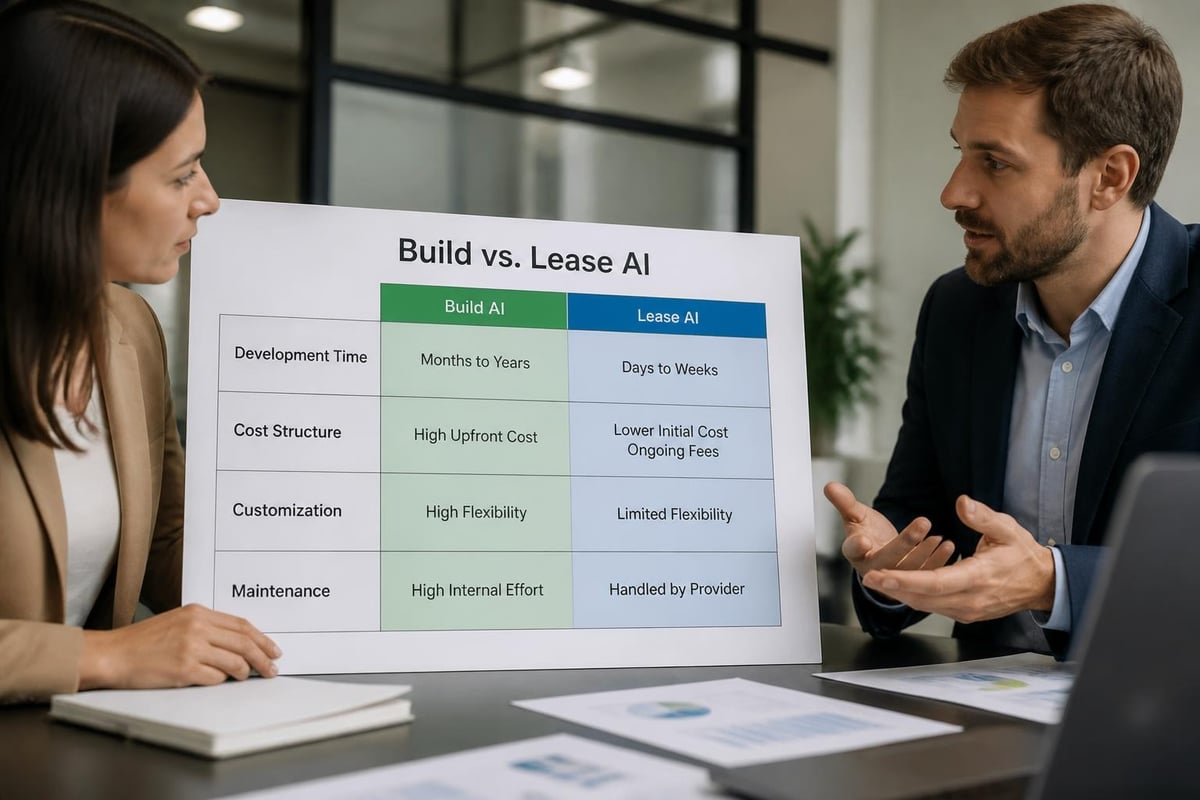
A critical strategic question in the business of AI involves whether to build proprietary systems or rely on third-party platforms. Enterprises are not building AI advantage, they are leasing it, which creates dependencies and limits customization potential.
Build Considerations:
- Full control over data and algorithms
- Customization for unique business processes
- Long-term cost efficiency
- Competitive differentiation
- Requires significant technical expertise
Lease/Platform Considerations:
- Rapid deployment and time-to-value
- Lower upfront investment
- Continuous updates and improvements
- Reduced maintenance burden
- Potential vendor lock-in risks
For most businesses, the optimal approach combines platform-based deployment with strategic customization. Solutions like those offered through AI Textura's hosting platform provide the infrastructure while allowing businesses to configure agents for their specific operational needs.
The Agentic Business Model Revolution
The business of AI is entering its agentic phase, where AI systems don't just assist but autonomously execute business functions. Small and medium-sized enterprises can leverage agentic AI to compete with larger competitors by automating critical workflows.
Autonomous Business Operations
Agentic AI represents a paradigm shift from reactive automation to proactive business execution. These systems monitor conditions, make decisions within defined parameters, and take actions without human intervention.
Real-world applications include:
- Sales agents that identify prospects, initiate contact, qualify interest, schedule demonstrations, and follow up until conversion
- Support agents that resolve technical issues, process refunds, escalate complex cases, and update knowledge bases based on new patterns
- Marketing agents that test campaign variations, adjust budgets based on performance, personalize content, and optimize send times
- HR agents that screen candidates, schedule interviews, conduct initial assessments, and manage onboarding workflows
The quick start process for deploying these agents has become remarkably streamlined, allowing businesses to launch functional AI workforces in days rather than months.
Integration Architecture for Business AI
The technical foundation of the business of AI rests on seamless integration across existing business systems. Modern AI agents must connect with CRM platforms, payment processors, communication channels, and data warehouses to deliver value.
| Integration Type | Business Purpose | Common Platforms | Implementation Complexity |
|---|---|---|---|
| CRM Systems | Customer data sync, interaction logging | Salesforce, HubSpot, AmoCRM | Medium |
| Communication Channels | Multi-channel customer engagement | WhatsApp, Telegram, Email, SMS | Low |
| Payment Processors | Transaction handling, invoice management | Stripe, PayPal, Square | Medium |
| Calendar Systems | Meeting scheduling, availability management | Google Calendar, Outlook | Low |
Businesses need AI that actually understands their specific operations rather than generic solutions requiring extensive customization.
Measuring ROI in the Business of AI
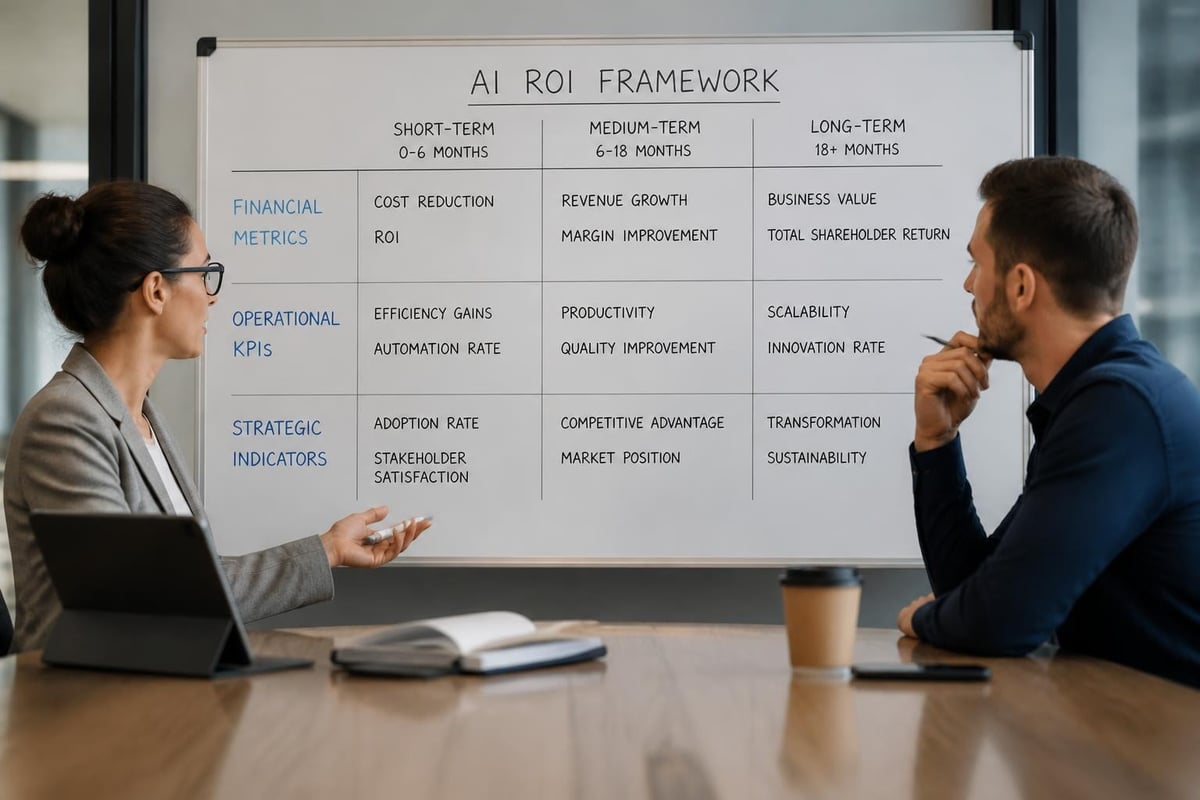
Quantifying returns from AI investments requires frameworks that capture both direct financial impact and strategic value creation. Traditional ROI calculations often miss the full picture.
Financial Metrics
Direct cost savings represent the most straightforward measurement. Calculate labor hours eliminated, error reduction costs, and overhead decreases attributable to AI implementation.
Formula components:
- Monthly labor cost savings = (Hours automated × Average hourly rate) × Team size
- Error reduction value = (Error rate decrease × Average error cost) × Transaction volume
- Scalability value = Revenue increase possible without proportional headcount growth
Operational Metrics
Operational improvements often precede financial gains. Track efficiency increases, response time reductions, and capacity expansions enabled by AI agents.
Speed matters in business. AI agents responding in seconds versus hours can mean the difference between closing a deal and losing it to competitors. The comparison of different AI solutions should include these operational performance indicators.
Strategic Metrics
Long-term competitive positioning metrics include market share growth, customer lifetime value increases, and new market entry capabilities. These indicators reflect AI's role in strategic business transformation rather than tactical optimization.
Industry-Specific Applications of Business AI
The business of AI manifests differently across sectors, with each industry developing unique use cases aligned with their operational challenges and customer expectations.
Hospitality and Tourism
Hotels, resorts, and travel companies deploy AI agents for reservation management, guest service, and personalized recommendations. These agents handle booking modifications, answer property questions, coordinate special requests, and manage post-stay feedback collection.
The hospitality-focused solutions demonstrate how vertical-specific AI configurations deliver higher value than generic implementations.
E-commerce and Retail
Online retailers use AI agents to guide product discovery, process orders, handle returns, and provide post-purchase support. The ability to operate across multiple languages and time zones transforms customer reach.
E-commerce AI applications:
- Product recommendation engines based on browsing behavior
- Inventory inquiry and availability checking
- Order tracking and shipment updates
- Size and fit guidance reducing returns
- Abandoned cart recovery campaigns
Professional Services
Consulting, legal, and accounting firms leverage AI for client intake, document processing, scheduling, and preliminary research. This allows professionals to focus on high-value advisory work while AI handles administrative overhead.
Manufacturing and Distribution
Supply chain optimization, quality control, and logistics coordination benefit from AI agents that monitor conditions, predict disruptions, and coordinate responses across complex networks.
Implementation Strategy for Business AI
Successfully capturing value from the business of AI requires deliberate implementation strategies that balance ambition with practical execution.
Phase 1: Process Identification
Begin by mapping business processes to identify high-impact, AI-suitable workflows. Look for repetitive tasks, high-volume interactions, and processes where delays create customer friction.
Evaluation criteria:
- Transaction volume and frequency
- Complexity level and variation
- Current cost and resource requirements
- Customer impact of delays or errors
- Data availability and quality
Phase 2: Pilot Deployment
Launch AI agents in controlled environments with clear success metrics. Start with processes where risk is manageable and results are measurable within weeks.
The practical applications of AI in business provide frameworks for structuring effective pilots that generate learning and build organizational confidence.
Phase 3: Scaling and Optimization
Expand successful AI deployments across departments and use cases. Optimize based on performance data, user feedback, and evolving business requirements.
Scaling considerations:
- Infrastructure capacity and reliability
- Training and change management
- Governance and compliance frameworks
- Performance monitoring systems
- Continuous improvement processes
Setting up working hours and availability parameters ensures AI agents align with business policies and customer expectations as deployments scale.
Phase 4: Ecosystem Integration
Mature AI implementations connect across the entire business ecosystem, sharing data, coordinating actions, and creating compound value through network effects.
Risk Management in AI Business Models
The business of AI introduces new risk categories that require deliberate management strategies alongside opportunity pursuit.
Operational Risks
AI system failures can disrupt business operations if not properly architected with redundancy and fallback mechanisms. Designing systems with human oversight options and graceful degradation capabilities mitigates operational exposure.
Data Privacy and Security
AI agents processing customer information must comply with regulations like GDPR, CCPA, and industry-specific requirements. Data handling practices, storage security, and access controls become critical business considerations.
| Risk Category | Mitigation Strategy | Implementation Priority |
|---|---|---|
| System Downtime | Redundant hosting, fallback protocols | High |
| Data Breaches | Encryption, access controls, audit logging | Critical |
| Compliance Violations | Regular audits, automated compliance checks | High |
| Quality Degradation | Continuous monitoring, performance thresholds | Medium |
| Vendor Dependency | Multi-platform capabilities, data portability | Medium |
Competitive and Strategic Risks
Over-reliance on generic AI solutions available to competitors may limit differentiation. Balancing standardization with customization preserves competitive advantage while managing implementation costs.
Future Directions in Business of AI
The trajectory of the business of AI points toward increasingly autonomous, context-aware systems that reshape competitive dynamics and business models.
Autonomous Business Models
Research into autonomous business models explores how AI agents will execute core business functions with minimal human intervention, fundamentally changing organizational structures and competitive strategies.
These models suggest businesses will increasingly compete on the quality and capabilities of their AI workforces rather than traditional human team advantages.
Adaptive Learning Systems
Next-generation business AI will continuously learn from interactions, adapting strategies based on outcomes without explicit reprogramming. This creates self-improving business processes that become more effective over time.
Multi-Agent Collaboration
Future implementations will feature specialized AI agents collaborating across functions. A sales agent might coordinate with a support agent and marketing agent to deliver unified customer experiences that no single system could provide.
Collaboration scenarios:
- Sales agent identifies upsell opportunity, marketing agent delivers targeted content, support agent ensures smooth implementation
- Support agent detects product feedback pattern, product development agent analyzes feasibility, communications agent updates customer base
- HR agent identifies skill gaps, training agent develops curriculum, performance agent tracks improvement metrics
The evolution toward collaborative AI ecosystems will require businesses to think beyond individual use cases toward integrated AI strategies.
The business of AI represents a fundamental shift in how organizations create value, serve customers, and compete in global markets. Success requires strategic thinking about where AI delivers maximum impact, careful implementation that balances automation with human expertise, and continuous optimization based on measurable results. AI Textura enables businesses to deploy AI agents that manage sales, support, marketing, and HR operations without coding or server management, transforming business operations through intelligent automation that takes real actions across your entire workflow ecosystem.