

The decision to build AI solutions has become less about whether to adopt artificial intelligence and more about how to implement it effectively. Businesses across industries are recognizing that AI agents can transform operations, handling everything from customer interactions to backend processes. The landscape has shifted dramatically, with platforms now offering capabilities that once required extensive coding knowledge and infrastructure investment. Understanding the right approach to build AI solutions can mean the difference between operational transformation and wasted resources.
Understanding Modern AI Development Approaches
When organizations decide to build AI systems, they face three primary pathways. Each approach offers distinct advantages depending on technical capabilities, budget constraints, and time requirements.
No-Code Platforms for Rapid Deployment
No-code AI platforms have democratized access to artificial intelligence. These solutions enable business users to build AI agents without writing a single line of code. The platforms provide intuitive interfaces where users configure behaviors, connect data sources, and deploy intelligent agents.
Key advantages of no-code approaches:
- Deployment timelines measured in days, not months
- Minimal technical expertise required
- Lower initial investment compared to custom development
- Built-in integrations with common business tools
- Immediate scalability without infrastructure management
Many businesses find that platforms designed specifically for AI agent deployment reduce complexity while maintaining powerful functionality. The ability to configure agents that operate across multiple languages and channels becomes critical for global operations.
Low-Code Development for Customization
Low-code environments strike a balance between accessibility and flexibility. These platforms provide visual development tools supplemented by the ability to inject custom code when needed. Organizations can build AI solutions that handle unique business logic while leveraging pre-built components for standard functions.
This approach suits businesses with specific workflow requirements that generic solutions cannot accommodate. Development teams can prototype rapidly, then refine implementations with targeted code additions. The result is faster time-to-market compared to traditional development without sacrificing customization.
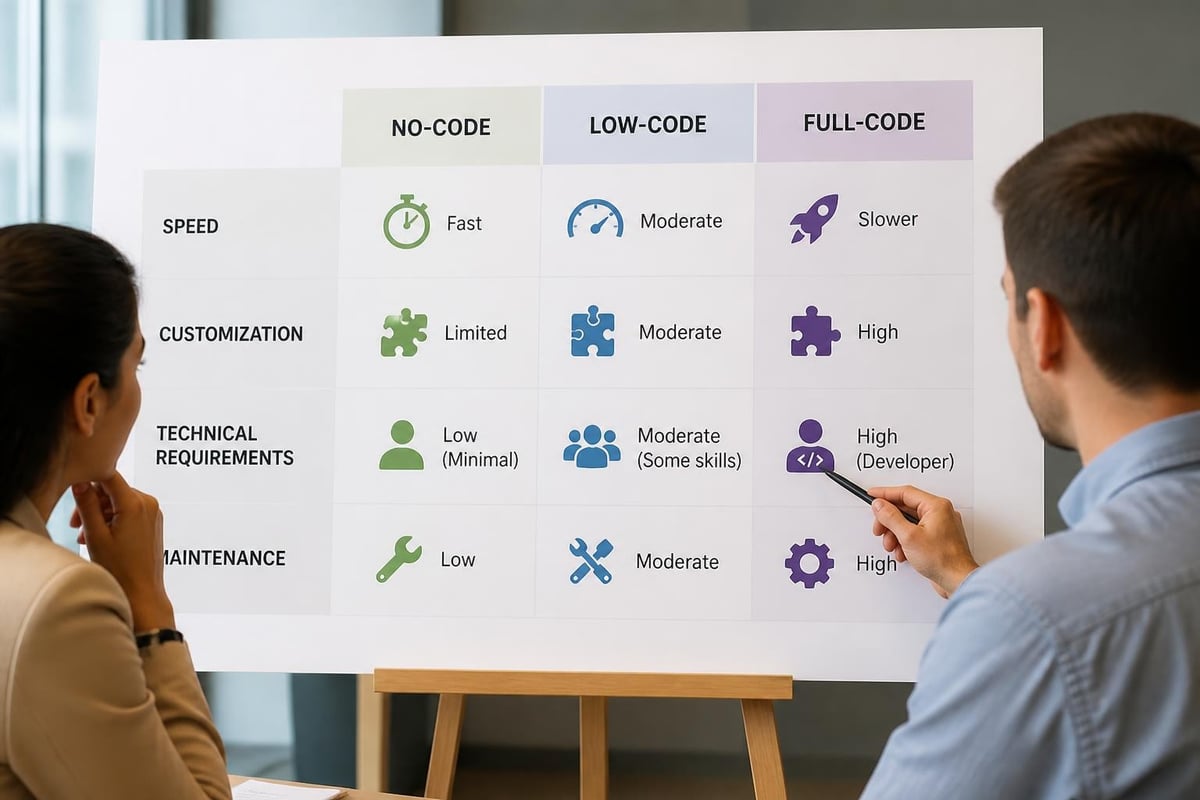
Full-Stack Custom Development
Organizations with complex requirements or unique competitive advantages may choose to build AI systems from the ground up. This path requires substantial investment in data science expertise, engineering resources, and infrastructure.
| Development Approach | Time to Deploy | Technical Skill Required | Customization Level | Maintenance Burden |
|---|---|---|---|---|
| No-Code | 1-2 weeks | Low | Moderate | Minimal |
| Low-Code | 4-8 weeks | Moderate | High | Moderate |
| Full-Stack | 3-6 months | Expert | Complete | Significant |
Custom development makes sense when proprietary algorithms provide competitive differentiation or when regulatory requirements demand complete control over data processing. However, most businesses find that their needs align better with platform-based approaches.
Critical Components When You Build AI Systems
Regardless of the development approach, certain foundational elements determine success when organizations build AI solutions. These components work together to create reliable, effective automation.
Data Quality and Management
AI systems are only as effective as the data they consume. Organizations must establish robust data pipelines that ensure accuracy, completeness, and timeliness. This means implementing validation rules, deduplication processes, and regular audits.
When businesses build AI agents for customer-facing roles, data quality directly impacts customer experience. An agent working with outdated product information or incorrect pricing creates frustration and erodes trust. Ensuring AI quality management becomes essential for scaling operations successfully.
Essential data considerations:
- Establish single sources of truth for critical business data
- Implement automated validation at collection points
- Create feedback loops to identify and correct errors
- Maintain clear data lineage for compliance requirements
- Regular testing with production-like datasets
Model Selection and Training
The choice of AI models fundamentally shapes what systems can accomplish. Modern platforms typically handle model selection automatically, but understanding the basics helps organizations make informed decisions.
For conversational AI agents, large language models (LLMs) have become the standard. These models understand context, generate human-like responses, and adapt to different communication styles. The key is selecting models appropriate for specific tasks rather than applying one-size-fits-all approaches.
Training or fine-tuning models on business-specific data improves performance dramatically. An AI agent trained on your product catalog, service procedures, and customer interaction history will outperform generic implementations. Many businesses leverage integration capabilities to connect AI systems with existing knowledge bases automatically.
Security and Compliance Framework
Security cannot be an afterthought when you build AI solutions. These systems often access sensitive customer data, financial information, and proprietary business intelligence. Implementing comprehensive security from the start prevents costly breaches and compliance violations.
AI security best practices address unique risks including data poisoning, model theft, and adversarial attacks. A multi-layered approach combines technical controls with governance processes.
Core security requirements:
- End-to-end encryption for data in transit and at rest
- Role-based access controls limiting system permissions
- Regular security audits and penetration testing
- Compliance with industry-specific regulations (GDPR, HIPAA, etc.)
- Incident response procedures for AI-specific threats

Designing Effective AI Agent Workflows
The structure of AI agent workflows determines operational efficiency. Well-designed workflows handle routine tasks autonomously while escalating complex situations appropriately. This balance maximizes automation benefits without creating customer service gaps.
Mapping Business Processes
Begin by documenting current processes in detail. Identify decision points, data requirements, and success criteria. This mapping reveals which tasks suit AI automation and where human intervention remains necessary.
For example, in hospitality operations, AI agents might handle booking confirmations, pre-arrival communications, and basic inquiries. Complex requests requiring judgment or special arrangements would route to human staff. Hotels implementing AI solutions typically see dramatic efficiency gains while maintaining service quality.
Building Conversation Flows
Natural conversation design separates effective AI agents from frustrating chatbots. Agents should understand intent regardless of phrasing variations, handle context across multiple exchanges, and respond appropriately to emotional cues.
When you build AI conversation systems, consider these elements:
- Intent recognition: Train systems to identify what users want from various phrasings
- Entity extraction: Pull relevant details (dates, names, numbers) from unstructured input
- Context maintenance: Remember conversation history to avoid repetitive questions
- Fallback handling: Gracefully manage misunderstandings with clarifying questions
- Handoff protocols: Smoothly transfer to humans when needed
Testing conversation flows with real users reveals gaps that specifications miss. Iterative refinement based on actual interactions improves performance rapidly.
Integration Architecture
AI agents deliver maximum value when integrated deeply with existing systems. An agent that can check inventory, update CRM records, process payments, and schedule appointments autonomously handles complete transactions rather than just information exchange.
Modern integration approaches leverage APIs to connect AI systems with:
- Customer relationship management platforms
- E-commerce and point-of-sale systems
- Scheduling and calendar tools
- Payment processors
- Email and messaging platforms
- Analytics and reporting systems
The channels and integrations available determine how seamlessly AI agents fit into existing technology ecosystems. Businesses should prioritize platforms offering pre-built connectors for their critical systems.
Implementation Best Practices for 2026
Current best practices for AI implementation reflect lessons learned from early adoption challenges. Organizations that follow proven approaches avoid common pitfalls and achieve faster ROI.
Start with High-Impact, Low-Complexity Use Cases
The temptation to build AI systems that do everything often leads to projects that deliver nothing. Successful implementations begin with focused applications that solve specific problems.
Identify processes that are:
- High-volume and repetitive
- Well-documented with clear procedures
- Time-consuming for human staff
- Not requiring complex judgment calls
- Measurable in terms of performance metrics
Customer service inquiries, appointment scheduling, and lead qualification typically meet these criteria. Success with initial projects builds organizational confidence and funding for broader initiatives.
Following AI development best practices ensures projects stay on track and deliver measurable results. Proper planning, testing, and deployment strategies prevent the quality issues that undermine user trust.
Establish Clear Performance Metrics
You cannot manage what you do not measure. Define specific, quantifiable metrics before deployment and track them consistently.
| Metric Category | Example Metrics | Target Ranges |
|---|---|---|
| Accuracy | Intent recognition rate, Response accuracy | >90% |
| Efficiency | Average handling time, Resolution rate | 60-80% reduction |
| User Satisfaction | CSAT score, Net Promoter Score | >4.0/5.0 |
| Business Impact | Cost per interaction, Revenue generated | 40-70% cost reduction |
Regular review of these metrics identifies improvement opportunities and demonstrates ROI to stakeholders. Many platforms provide built-in analytics dashboards that track key performance indicators automatically.

Implement Continuous Learning Processes
AI systems improve through exposure to new data and feedback. Establishing mechanisms for continuous learning ensures performance increases over time rather than stagnating.
Continuous improvement strategies:
- Regular review of conversation logs to identify misunderstandings
- A/B testing different response approaches
- User feedback collection after interactions
- Periodic retraining with updated business information
- Monitoring for concept drift and model degradation
Organizations that build AI with improvement processes built-in see compounding benefits. Early performance gains accelerate as systems learn from thousands or millions of interactions.
Plan for Scalability from Day One
An AI solution that works perfectly for 100 interactions per day may collapse under 10,000. Scalability considerations should inform architecture decisions from the beginning.
Cloud-based platforms typically handle scaling automatically, adding resources as demand increases. Self-hosted solutions require capacity planning, load balancing, and monitoring infrastructure. For most businesses, managed platforms eliminate operational complexity while ensuring systems scale seamlessly with growth.
The decision to build AI on platforms that handle infrastructure automatically versus managing your own servers depends on technical capabilities and control requirements. Best practices for scalable AI applications emphasize modular architecture and efficient resource management.
Overcoming Common Implementation Challenges
Even well-planned AI projects encounter obstacles. Understanding common challenges and proven solutions accelerates successful deployment.
Managing Stakeholder Expectations
Unrealistic expectations about AI capabilities create disappointment and resistance. Clear communication about what AI can and cannot do prevents these issues.
AI agents excel at handling routine, structured tasks with consistency and speed. They struggle with nuanced judgment, creative problem-solving, and situations requiring empathy beyond scripted responses. Setting appropriate expectations helps stakeholders appreciate real benefits rather than focusing on limitations.
Addressing User Adoption Resistance
Both customers and employees may resist AI-powered interactions. Customers worry about impersonal service, while employees fear job displacement. Thoughtful change management addresses these concerns.
For customer-facing AI, emphasize always-available support, faster response times, and consistent quality. Make human escalation easy and obvious. Many organizations find that customers appreciate AI assistance for simple tasks, freeing human agents for complex situations requiring personal attention.
Employee concerns require transparent communication about how AI augments rather than replaces human workers. When staff see AI handling tedious routine tasks, allowing them to focus on interesting, high-value work, resistance typically decreases. Training programs that help employees work effectively alongside AI systems build confidence.
Handling Edge Cases and Errors
No AI system handles every situation perfectly. Planning for errors and edge cases prevents customer frustration and operational disruptions.
Implement clear escalation paths when AI agents encounter situations beyond their capabilities. Design error messages that maintain user confidence while smoothly transitioning to alternative solutions. Regular review of escalated cases identifies patterns that inform system improvements.
AI coding best practices from experienced developers emphasize defensive programming, comprehensive testing, and graceful failure handling. These principles apply whether you build AI through code or configuration.
Regulatory and Ethical Considerations
As AI systems become more capable and autonomous, regulatory scrutiny increases. Organizations must build AI with compliance and ethics embedded from the start.
Data Privacy and User Consent
Regulations like GDPR and CCPA impose strict requirements on how businesses collect, process, and store personal data. AI systems that analyze customer information must comply with these frameworks.
Key compliance requirements:
- Explicit consent for data collection and processing
- Clear privacy policies explaining AI system usage
- User rights to access, correct, and delete their data
- Data minimization (collecting only what's necessary)
- Geographic restrictions on data storage and processing
Many businesses serve customers across multiple jurisdictions, requiring compliance with various regulatory frameworks simultaneously. Platforms operating in over 90 languages and multiple regions must build privacy compliance into their core architecture.
Transparency and Explainability
Users increasingly demand to know when they interact with AI systems and how those systems make decisions. Building transparency into AI agents strengthens trust and satisfies regulatory requirements.
Disclosure that users are communicating with AI should be clear but not disruptive. Many implementations include subtle indicators in chat interfaces or brief initial disclosures. For decisions that significantly impact users (credit approvals, content moderation), explainability becomes critical.
Bias Prevention and Fairness
AI systems can perpetuate or amplify biases present in training data. Organizations must actively work to identify and mitigate bias when they build AI solutions.
Testing AI performance across diverse demographic groups reveals disparate impacts. Regular audits using fairness metrics help maintain equitable treatment. Diverse development teams bring varied perspectives that identify potential bias issues earlier in the development process.
Future-Proofing Your AI Investment
Technology evolves rapidly, particularly in artificial intelligence. Building systems with longevity requires attention to flexibility and adaptability.
Platform Selection Criteria
The platform or framework you choose to build AI solutions significantly impacts long-term success. Evaluation criteria should include:
- Update frequency: How often does the platform incorporate new AI capabilities?
- Vendor stability: Is the provider financially sound with long-term viability?
- Migration options: Can you export data and configurations if needed?
- Community and support: Is there active user community and responsive support?
- Standards compliance: Does the platform follow industry standards and protocols?
Organizations should carefully evaluate whether open-source AI development or proprietary platforms better serve their needs. Each approach offers distinct advantages in terms of flexibility, support, and total cost of ownership.
Maintaining Competitive Advantage
As AI adoption becomes universal, the competitive advantage shifts from simply having AI to how effectively it's implemented and continuously improved. Organizations that build AI systems with ongoing optimization processes maintain their edge.
High-velocity AI development practices enable rapid iteration and experimentation. Agile methodologies adapted for AI projects allow businesses to respond quickly to market changes and customer feedback.
Innovation in AI application matters more than technology sophistication. Creative applications of existing AI capabilities often deliver more value than waiting for next-generation technology. The key is identifying unique ways AI solves real business problems rather than implementing technology for its own sake.
Building Organizational AI Capabilities
Sustainable AI success requires developing internal expertise. Even organizations using no-code platforms benefit from staff who understand AI principles, best practices, and strategic applications.
Investment in training builds organizational capability to identify new AI opportunities, evaluate vendor claims critically, and troubleshoot issues independently. As AI becomes more central to operations, this expertise transitions from a nice-to-have to a business necessity.
Cross-functional AI literacy ensures marketing, sales, operations, and executive teams share common understanding of capabilities and limitations. This alignment prevents both over-investment in low-value applications and missed opportunities for high-impact implementations.
Successfully implementing AI requires balancing technical capabilities with practical business needs, choosing the right development approach for your organization's resources and requirements. Whether you build AI through no-code platforms, custom development, or hybrid approaches, focusing on clear use cases, robust data practices, and continuous improvement delivers the best results. AI Textura enables businesses to deploy intelligent agents handling sales, support, marketing, and HR operations without coding or server management, offering a practical path to AI-powered automation that scales with your business across industries and languages.