

The landscape of software development has undergone a fundamental transformation as artificial intelligence reshapes how code is written, reviewed, and deployed. AI for code represents more than just autocomplete features or syntax suggestions. It encompasses sophisticated systems capable of generating complete applications, identifying security vulnerabilities, and automating repetitive development tasks that once consumed countless hours. Organizations across industries are discovering that AI for code solutions can accelerate time-to-market while reducing the technical barriers that have traditionally separated business vision from software execution.
The Evolution of AI-Powered Code Generation
Traditional software development followed a linear path where human developers translated business requirements into functional code. This process demanded extensive technical expertise, time, and resources. Modern AI for code platforms have disrupted this model by introducing intelligent systems that understand natural language descriptions and convert them into working applications.
The sophistication of these systems has advanced dramatically since their early iterations. Research on AI-assisted code generation demonstrates that contemporary models can produce code across multiple programming languages with impressive accuracy rates. These capabilities extend beyond simple function generation to encompass entire application architectures.
Key Capabilities Driving Adoption
Organizations implementing AI for code solutions benefit from several core capabilities:
- Natural language to code transformation that allows non-technical stakeholders to describe functionality in plain English
- Automated testing and quality assurance that identifies potential issues before deployment
- Code refactoring assistance that modernizes legacy systems without complete rewrites
- Real-time documentation generation that maintains accurate technical specifications
- Security vulnerability detection that proactively identifies potential exploits
The business impact extends beyond development speed. Companies report reduced onboarding time for new developers, improved code consistency across teams, and enhanced collaboration between technical and non-technical staff members.
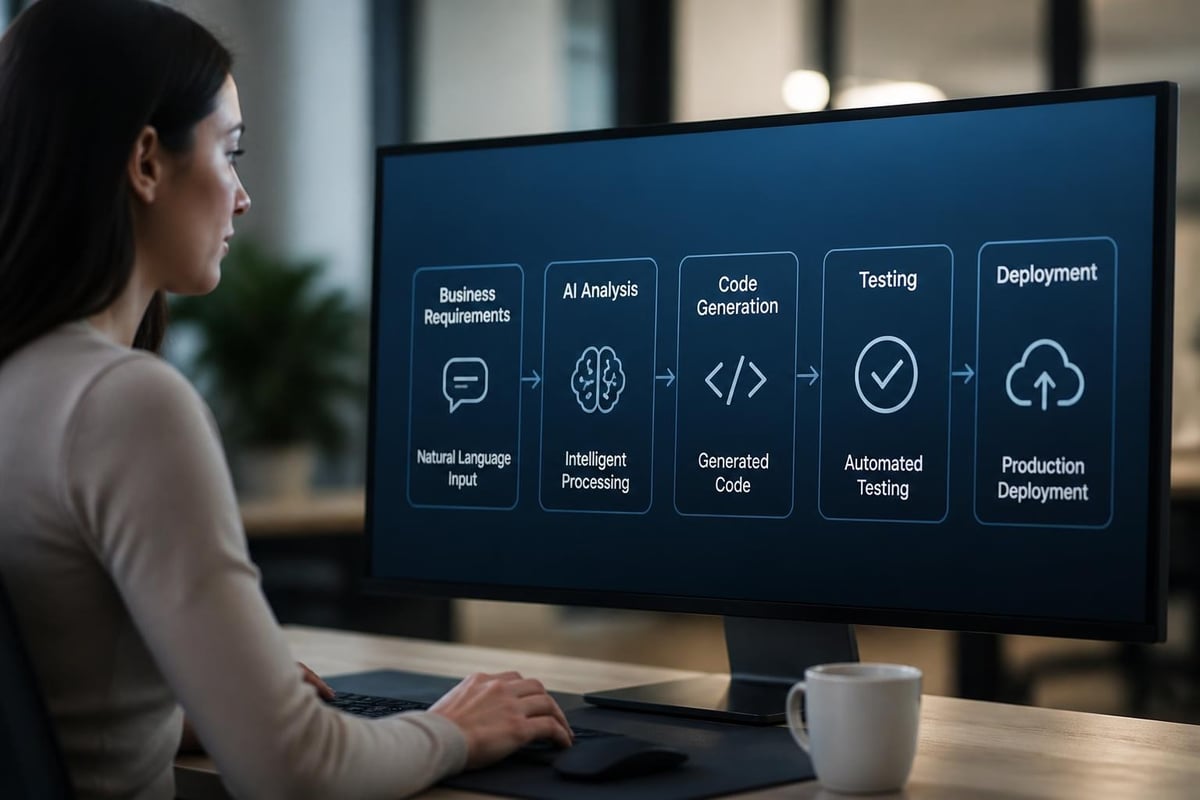
Enterprise Applications Transforming Business Operations
The practical applications of AI for code have expanded well beyond traditional software development environments. Enterprises now leverage these technologies to automate business-critical workflows without maintaining extensive development teams.
| Use Case | Traditional Approach | AI for Code Approach |
|---|---|---|
| CRM Integration | 2-3 weeks, dedicated developers | 2-3 days, business analysts |
| Workflow Automation | Custom code for each process | Natural language workflow design |
| Report Generation | Manual SQL and scripting | Conversational data queries |
| API Connections | Technical integration specialists | Automated connector generation |
Breaking Down Technical Barriers
The democratization of software creation represents one of the most significant shifts enabled by AI for code. The concept of vibe coding illustrates how individuals without formal programming training can now build functional applications through intuitive interfaces and natural language prompts.
This accessibility transformation particularly benefits small and medium-sized businesses that previously lacked resources for comprehensive digital transformation initiatives. Marketing teams can create custom automation workflows, sales departments can build prospect tracking systems, and operations managers can design process management tools without waiting months for IT department availability.
However, this democratization requires thoughtful governance frameworks. Organizations must establish guidelines ensuring code quality, security standards, and maintainability even when generated by non-developers using AI for code platforms.
Quality Assurance and Security Considerations
As AI for code adoption accelerates, questions about code quality and security vulnerabilities have emerged as critical concerns. Studies examining AI-assisted code generation quality reveal nuanced findings regarding the reliability, security, and maintainability of machine-generated code.
Security Implications of Rapid Code Generation
The ability to generate code quickly introduces both opportunities and risks. Analysis of AI-generated code security highlights that while development velocity increases dramatically, organizations must implement robust review processes to catch potential vulnerabilities that AI systems might introduce.
Security considerations when implementing AI for code include:
- Input validation vulnerabilities where AI may generate code lacking proper sanitization
- Authentication weaknesses in automatically generated access control logic
- Data exposure risks from AI models trained on public repositories containing sensitive patterns
- Dependency management challenges when AI selects outdated or vulnerable libraries
- Compliance gaps where generated code fails to meet industry-specific regulatory requirements
Organizations successfully deploying AI for code typically combine automated generation with human oversight layers. This hybrid approach maintains development velocity while ensuring security standards remain uncompromised.
Selecting the Right AI Coding Assistant
The market for AI for code solutions has expanded rapidly, with numerous platforms offering distinct capabilities and specializations. Evaluating options requires understanding both technical capabilities and organizational fit.
Comparative Framework for Evaluation
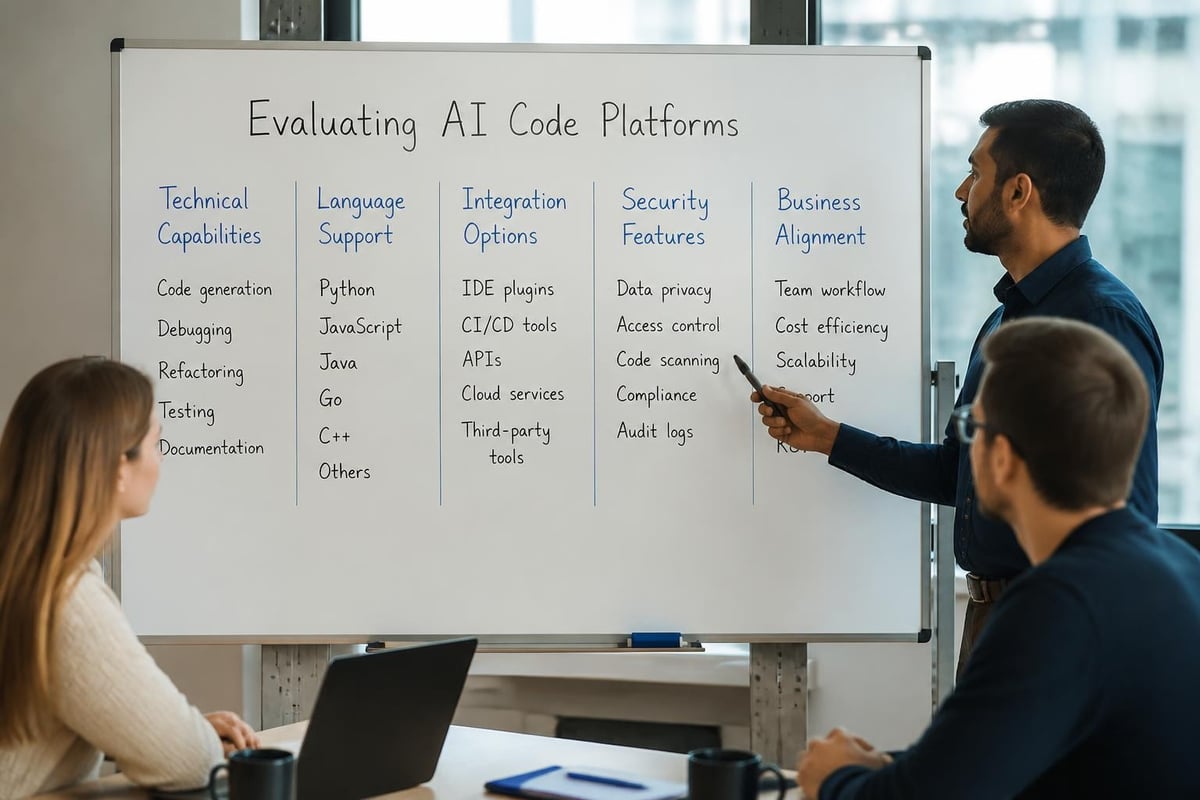
When assessing AI for code platforms, organizations should examine several dimensions:
Technical Capabilities:
- Supported programming languages and frameworks
- Integration with existing development environments
- Code completion accuracy and context awareness
- Ability to understand and work with legacy codebases
- Support for multiple natural languages beyond English
Business Alignment:
- Learning curve for non-technical users
- Pricing models and total cost of ownership
- Compliance with data privacy regulations
- Availability of support and training resources
- Scalability for growing teams and projects
Comprehensive reviews of AI tools provide starting points for research, though organizations should conduct hands-on evaluations with their specific use cases and workflows. Platforms like AI Textura demonstrate how AI for code principles extend beyond traditional development into complete business process automation.
Integration with Existing Development Workflows
Successful AI for code implementation requires thoughtful integration with established development practices rather than complete replacement of existing processes. Organizations that treat AI as an augmentation tool rather than a wholesale substitute typically achieve better outcomes.
Development Team Adaptation Strategies
Teams incorporating AI for code into their workflows benefit from structured adoption approaches:
- Gradual introduction starting with non-critical projects to build confidence
- Clear role definitions distinguishing when AI assistance is appropriate versus requiring human expertise
- Code review protocols specifically designed for AI-generated contributions
- Knowledge sharing sessions where team members discuss successful AI for code applications
- Performance metrics that measure both velocity improvements and quality maintenance
The CodeNet dataset and similar research resources provide insights into how AI systems understand and generate code across different languages and paradigms, informing better integration strategies.
Industry-Specific Applications and Case Studies
Different industries leverage AI for code in ways that align with their unique operational challenges and regulatory environments.
Hospitality and Customer Service Automation
Hotels, restaurants, and customer-facing businesses use AI for code to build reservation systems, guest communication platforms, and service request management tools. These implementations typically prioritize multilingual support and integration with existing property management systems.
The ability to rapidly prototype and deploy customer service automation without extensive development cycles allows hospitality businesses to respond quickly to changing guest expectations. AI for code platforms enable properties to create custom booking flows, automated response systems, and personalized guest experience tools.
E-commerce and Retail Operations
Retail organizations apply AI for code to inventory management, dynamic pricing systems, and customer engagement platforms. The focus centers on real-time data processing and integration with multiple sales channels.
| Retail Application | Development Timeline | Key AI for Code Benefits |
|---|---|---|
| Inventory Forecasting | 40% faster implementation | Automated data pipeline creation |
| Personalization Engines | 60% reduction in coding time | Natural language business rules |
| Order Management | 50% fewer custom integrations | Pre-built connector generation |
Professional Services and Agency Work
Marketing agencies, consulting firms, and professional services organizations leverage AI for code to build client-specific reporting dashboards, campaign management tools, and project tracking systems. The emphasis falls on customization speed and client-facing presentation quality.

The Human-AI Collaboration Model
The most effective implementations of AI for code recognize that artificial intelligence augments rather than replaces human expertise. This collaboration model leverages the strengths of both human creativity and machine processing power.
Defining Complementary Roles
Developers working alongside AI for code systems typically focus on:
- Strategic architecture decisions that require business context understanding
- Complex problem decomposition where creative approaches yield advantages
- Edge case handling that falls outside typical patterns
- Quality validation ensuring generated code meets standards
- Knowledge transfer teaching AI systems about domain-specific requirements
Meanwhile, AI for code excels at:
- Repetitive code generation for standard patterns and structures
- Syntax accuracy across multiple programming languages
- Pattern recognition identifying optimal solutions from vast codebases
- Documentation creation maintaining up-to-date technical specifications
- Refactoring assistance modernizing legacy code systematically
This division of labor allows organizations to maximize productivity while maintaining code quality and innovation capacity.
Future Developments and Emerging Trends
The trajectory of AI for code development points toward increasingly sophisticated systems capable of understanding complex business logic and generating entire application ecosystems. Several emerging trends will shape the next evolution of these technologies.
Autonomous Development Agents
Recent developments like Claude Code demonstrate movement toward fully autonomous coding assistants that can execute complete development tasks from initial conception through testing and deployment. These systems represent a shift from code suggestion to comprehensive application creation.
The rapid adoption of AI coding applications signals growing confidence in machine-generated code quality and reliability. As these tools mature, they will likely incorporate more sophisticated understanding of business requirements and user intent.
Multi-Modal Development Interfaces
Future AI for code platforms will likely support diverse input methods beyond text:
- Voice-based coding allowing developers to describe functionality verbally
- Visual design to code converting wireframes and mockups directly into working applications
- Collaborative AI pairing where multiple AI systems work together on complex projects
- Context-aware suggestions that understand entire project ecosystems
- Automated performance optimization identifying and implementing efficiency improvements
Enhanced Domain Specialization
AI for code systems will increasingly specialize in specific industries and use cases, developing deep understanding of sector-specific requirements, compliance needs, and best practices. This specialization enables more accurate code generation that requires less human modification.
Measuring Return on Investment
Organizations implementing AI for code need frameworks for evaluating the business impact and return on investment. Traditional software development metrics require adaptation for AI-augmented environments.
Quantitative Performance Indicators
- Development velocity: Time from requirement specification to working code
- Code quality metrics: Bug rates, security vulnerabilities, maintainability scores
- Resource utilization: Developer hours saved, cost per feature delivered
- Time to market: Product launch timelines compared to traditional approaches
- Maintenance overhead: Ongoing support requirements for AI-generated code
Qualitative Success Factors
Beyond numbers, successful AI for code implementations demonstrate:
- Improved collaboration between technical and non-technical teams
- Enhanced developer satisfaction through reduction of repetitive tasks
- Greater business agility responding to market changes
- Increased innovation capacity as teams focus on strategic challenges
- Reduced technical debt through consistent code quality
Organizations should establish baseline measurements before implementing AI for code solutions and track improvements across both quantitative and qualitative dimensions.
Implementation Best Practices
Deploying AI for code effectively requires structured approaches that address technical, organizational, and cultural dimensions.
Technical Implementation Steps
- Pilot project selection: Choose low-risk, high-value projects for initial testing
- Integration planning: Map connections between AI tools and existing systems
- Security framework: Establish code review and vulnerability scanning protocols
- Training data preparation: Curate examples representing desired code quality
- Rollout phases: Gradually expand usage based on success metrics
Organizational Change Management
Successful adoption addresses human factors alongside technical capabilities:
- Stakeholder education helping teams understand AI for code capabilities and limitations
- Role evolution support as developers transition toward more strategic responsibilities
- Success celebration highlighting wins achieved through AI assistance
- Continuous learning encouraging experimentation and skill development
- Feedback loops incorporating user experiences into platform selection and usage
Businesses exploring alternatives to traditional development should examine how platforms like AI Textura compare to conventional coding approaches when evaluating implementation strategies.
AI for code has evolved from experimental technology to practical business tool, enabling organizations to accelerate development, reduce technical barriers, and automate complex workflows. The key to success lies in thoughtful implementation that combines AI capabilities with human expertise while maintaining security and quality standards. AI Textura extends these principles beyond traditional coding into comprehensive business process automation, offering AI agents that handle sales, support, marketing, and HR operations across 90+ languages without requiring coding expertise or server management. Whether you're looking to streamline operations or build customer-facing automation, AI-powered solutions can transform how your business operates.