

The landscape of business automation has undergone a dramatic transformation with the emergence of ai code generation technologies. What once required teams of developers and months of implementation can now be accomplished through AI-powered platforms that translate business requirements into functional operations. This shift represents more than just faster development-it fundamentally changes how organizations approach automation, making sophisticated business processes accessible to companies without extensive technical resources. As we navigate 2026, understanding how ai code influences modern business operations has become essential for competitive advantage.
The Evolution of AI Code Generation
AI code generation has matured from experimental tools into production-ready systems that power critical business functions. Recent large-scale empirical studies on AI-generated code reveal that machine-generated code now comprises a significant portion of modern software development, marking a fundamental shift in how we build digital solutions.
The technology behind ai code generation relies on sophisticated large language models trained on vast repositories of programming languages and business logic. These systems understand not just syntax but the underlying patterns and best practices that make code functional and maintainable.
From Traditional Coding to Natural Language Commands
Traditional software development required deep technical expertise in programming languages, frameworks, and deployment infrastructure. Developers spent countless hours translating business requirements into technical specifications, then into actual code, followed by extensive testing and debugging.
Modern ai code platforms eliminate many of these steps by:
- Converting natural language descriptions directly into functional operations
- Automatically handling infrastructure and deployment complexities
- Managing integrations across multiple business systems
- Providing real-time updates without code rewrites
- Supporting multilingual capabilities from the ground up
This transformation allows businesses to get started quickly with AI-powered automation without navigating traditional development cycles.

Business Applications of AI Code Technology
The practical applications of ai code extend far beyond simple chatbots or basic automation. Modern AI agents built on this technology can execute complex business workflows that previously required custom software development.
Sales and Revenue Operations
AI-powered agents handle sophisticated sales processes including lead qualification, product recommendations, pricing negotiations, and transaction processing. These systems integrate directly with existing CRM platforms, updating records and maintaining accurate pipeline data without manual intervention.
| Sales Function | Traditional Approach | AI Code Solution |
|---|---|---|
| Lead Qualification | Manual review by sales team | Automated scoring and routing |
| Product Recommendations | Static scripts or human judgment | Dynamic AI-driven suggestions |
| CRM Updates | Manual data entry after calls | Automatic real-time synchronization |
| Follow-up Scheduling | Calendar management by reps | Intelligent timing optimization |
The hospitality sector particularly benefits from specialized AI solutions that handle booking inquiries, room availability, and guest services across multiple languages without traditional booking engine integration costs.
Customer Support and Service
Customer support represents one of the most immediate applications for ai code-driven automation. AI agents manage incoming inquiries through multiple communication channels, resolving common issues while escalating complex situations to human team members.
These systems operate continuously, providing consistent service quality regardless of volume fluctuations or time zones. The ability to function in over 90 languages means businesses can offer localized support without hiring multilingual staff for every market.
Security Considerations in AI Code Implementation
While ai code accelerates development and deployment, it introduces unique security considerations that businesses must address. AI is creating code faster, but this also means more potential security issues that require careful oversight and validation.
Critical security factors include:
- Data Privacy Compliance: Ensuring AI agents handle customer information according to regional regulations
- Access Control: Limiting what actions AI systems can perform without human approval
- Audit Trails: Maintaining comprehensive logs of all AI-initiated actions
- Input Validation: Preventing malicious prompts from compromising system integrity
- Integration Security: Protecting credentials and API keys used by AI agents
Organizations deploying AI-powered automation should implement robust monitoring systems and establish clear protocols for reviewing AI actions, particularly for operations involving financial transactions or sensitive customer data.

The Rise of No-Code AI Platforms
The democratization of ai code through no-code platforms represents a paradigm shift in who can implement business automation. IBM's comprehensive overview of AI code generation highlights how these systems streamline software development by removing traditional coding barriers.
Accessibility for Non-Technical Teams
No-code AI platforms enable marketing managers, operations directors, and customer service leaders to deploy sophisticated automation without involving IT departments for every change. This agility proves particularly valuable in fast-moving industries where competitive advantage depends on rapid adaptation.
The concept of "vibe coding" has emerged, allowing individuals with minimal technical expertise to create functional applications through conversational prompts. While this approach has limitations for complex enterprise systems, it demonstrates how ai code technologies are lowering barriers to entry.
Integration Capabilities
Modern AI platforms connect seamlessly with existing business infrastructure through extensive integration options. Rather than replacing current systems, AI agents augment them by automating repetitive tasks and providing intelligent decision support.
These integrations span:
- Customer relationship management systems
- E-commerce platforms and payment processors
- Communication channels including email, messaging apps, and phone systems
- Marketing automation and analytics tools
- Human resources and employee management software
The platform approach allows businesses to start with specific use cases and expand AI capabilities incrementally as they gain confidence and identify additional opportunities.
Measuring AI Code Performance and ROI
Successful ai code implementation requires clear metrics to evaluate effectiveness and justify continued investment. Unlike traditional software development where success often focuses on feature completion, AI automation demands ongoing performance measurement.
Key Performance Indicators
Different business functions require tailored metrics that reflect their unique objectives and constraints. Sales-focused AI agents might track conversion rates and average deal size, while support-oriented systems measure resolution time and customer satisfaction scores.
| Department | Primary Metrics | Secondary Metrics |
|---|---|---|
| Sales | Conversion rate, Revenue generated | Response time, Lead qualification accuracy |
| Support | Resolution rate, CSAT scores | Average handle time, Escalation rate |
| Marketing | Campaign engagement, Lead quality | Content personalization effectiveness |
| HR | Application processing time, Candidate experience | Interview scheduling efficiency |
Businesses should establish baseline measurements before deploying AI automation, enabling accurate before-and-after comparisons. Regular monitoring through status tracking ensures systems maintain expected performance levels.
Cost-Benefit Analysis
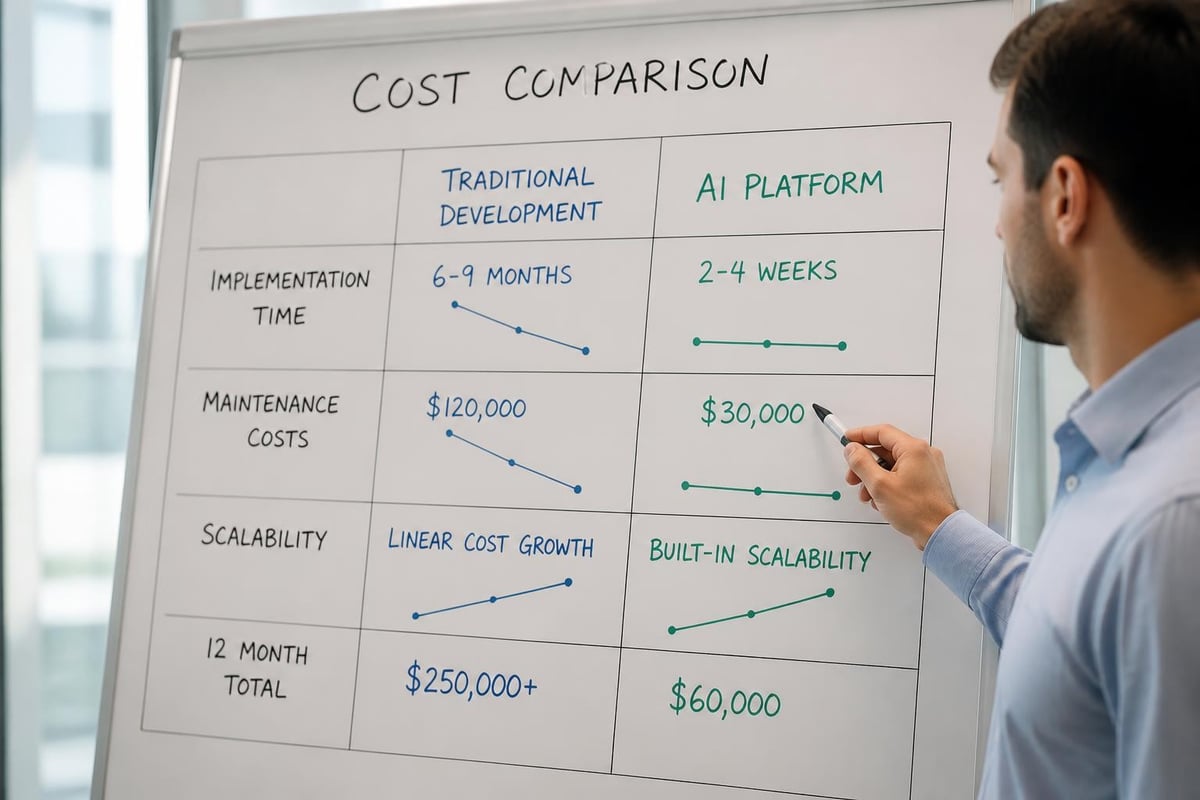
Traditional software development requires significant upfront investment in development resources, infrastructure, and ongoing maintenance. AI code platforms typically operate on subscription models that include infrastructure, updates, and support, simplifying budget planning.
Cost considerations include:
- Monthly or annual platform subscriptions
- Integration setup and customization
- Training for team members who manage AI agents
- Reduced staffing needs for routine tasks
- Increased capacity to handle volume without proportional hiring
Most organizations see positive ROI within months of deployment, particularly when starting with high-volume, repetitive processes that currently consume significant human resources.
Industry-Specific Applications
Different industries leverage ai code in ways that reflect their unique operational challenges and customer expectations. Understanding these sector-specific applications helps businesses identify relevant use cases and best practices.
Hospitality and Travel
Hotels, resorts, and travel companies use AI agents to manage reservations, respond to guest inquiries, and coordinate services across properties. The multilingual capabilities prove essential for international hospitality businesses serving diverse guest populations.
AI systems handle booking modifications, special requests, and pre-arrival communications while integrating with property management systems to ensure accuracy. Detailed case studies demonstrate how these implementations improve guest satisfaction while reducing operational overhead.
E-Commerce and Retail
Online retailers deploy AI agents for product recommendations, order tracking, return processing, and customer inquiries. These systems analyze customer behavior patterns to provide personalized shopping experiences that drive conversion and repeat business.
The ability to scale support during peak shopping periods without temporary staff hiring represents a significant operational advantage. AI agents maintain consistent brand voice and product knowledge regardless of volume fluctuations.
Professional Services
Consulting firms, agencies, and service providers use ai code-driven automation for client onboarding, project status updates, and scheduling coordination. These applications free senior professionals to focus on high-value client work while maintaining excellent communication standards.
Implementation Best Practices
Deploying ai code successfully requires thoughtful planning and phased rollout rather than attempting comprehensive automation overnight. Organizations that achieve the best results follow systematic approaches that build confidence and demonstrate value incrementally.
Starting with High-Impact Use Cases
Identify processes that are:
- High-volume and repetitive
- Well-documented with clear procedures
- Time-consuming for staff but straightforward in execution
- Non-critical enough to tolerate initial learning curves
- Measurable for clear performance tracking
Customer FAQ responses, appointment scheduling, and basic information requests typically represent excellent starting points that deliver quick wins without risking critical business functions.
Training and Knowledge Management
AI agents perform best when equipped with comprehensive, accurate information about products, services, policies, and procedures. Effective knowledge management ensures AI systems provide consistent, helpful responses that reflect current business practices.
This requires ongoing maintenance as products change, policies update, and new situations emerge. Successful organizations assign ownership for AI knowledge bases and establish regular review cycles.
Human-AI Collaboration
The most effective implementations treat AI agents as team members that handle routine tasks while escalating complex situations to human colleagues. Configuring appropriate profiles and permissions ensures AI systems operate within defined boundaries while maintaining service quality.
Clear escalation protocols prevent AI agents from attempting to handle situations beyond their capabilities. Customers should always have access to human support when needed, maintaining trust and satisfaction even as AI handles increasing volumes.
Future Directions in AI Code Technology
The ai code landscape continues evolving rapidly, with emerging capabilities that promise even more sophisticated business automation. Understanding these trends helps organizations prepare for upcoming opportunities and challenges.
Multimodal Capabilities
Next-generation AI systems will process not just text but images, voice, video, and structured data simultaneously. This enables more natural interactions and expands the range of tasks AI agents can handle autonomously.
Enhanced Decision-Making
Current AI automation excels at executing defined processes but requires human judgment for complex decisions. Advancing ai code systems incorporate more sophisticated reasoning capabilities, handling nuanced situations that currently require escalation.
Industry-Specific Specialization
Rather than general-purpose platforms, we're seeing emergence of AI solutions tailored for specific industries with pre-built knowledge, workflows, and integrations relevant to particular sectors. This specialization reduces implementation time and improves initial performance.
Regulatory and Compliance Landscape
As ai code becomes more prevalent in business operations, regulatory frameworks continue developing to address concerns around transparency, accountability, and consumer protection. Organizations must stay informed about requirements in their jurisdictions and industries.
Compliance considerations include:
- Disclosure Requirements: Informing customers when they're interacting with AI systems
- Data Handling: Meeting privacy regulations for AI processing of personal information
- Decision Transparency: Explaining how AI systems reach conclusions affecting customers
- Human Oversight: Maintaining appropriate review of AI actions in sensitive contexts
- Bias Prevention: Ensuring AI systems treat all customers fairly and equitably
Platforms that prioritize compliance features, including comprehensive changelog tracking and audit capabilities, help businesses meet regulatory obligations while benefiting from AI automation.
Selecting the Right AI Code Platform
The growing market for AI automation platforms presents both opportunities and challenges for businesses evaluating options. Different platforms emphasize various capabilities, making careful assessment essential for successful implementation.
Evaluation Criteria
Organizations should assess platforms across multiple dimensions including technical capabilities, ease of use, integration options, pricing models, and vendor support quality. The right choice depends heavily on specific business requirements and existing infrastructure.
Technical considerations include:
- Supported languages and regions
- Integration capabilities with existing systems
- Customization flexibility for unique workflows
- Performance and reliability track records
- Security and compliance certifications
Operational factors encompass:
- Implementation timeline and resource requirements
- Training needs for administrative users
- Ongoing maintenance responsibilities
- Vendor support availability and responsiveness
- Scalability as business needs grow
Trial periods and proof-of-concept projects help validate platform capabilities before full commitment, reducing implementation risk and ensuring alignment with business needs.
The transformation enabled by ai code represents a fundamental shift in how businesses approach automation and operational efficiency. By converting business requirements directly into functional AI agents without traditional coding barriers, organizations can rapidly deploy sophisticated automation across sales, support, marketing, and operational functions. AI Textura provides exactly this capability-a platform for hosting AI agents that manage business operations across 90+ languages without requiring code or servers, enabling businesses to take real actions like booking, selling, and updating CRM systems with confidence and reliability.