

The evolution of artificial intelligence has fundamentally changed how businesses communicate with customers and manage operations. AI channels represent the pathways through which AI agents interact with customers, employees, and systems across multiple platforms simultaneously. These communication routes enable businesses to maintain consistent, intelligent conversations whether customers reach out via email, chat, phone, or social media. Understanding how to effectively deploy and manage ai channels has become essential for companies looking to scale their operations without proportionally increasing headcount.
Understanding AI Channel Architecture
Modern ai channels function as sophisticated communication bridges that connect AI agents to the outside world. Unlike traditional chatbots limited to a single platform, today's AI workforce operates across numerous touchpoints simultaneously, maintaining context and conversation history regardless of where the interaction occurs.
Core Components of AI Channels
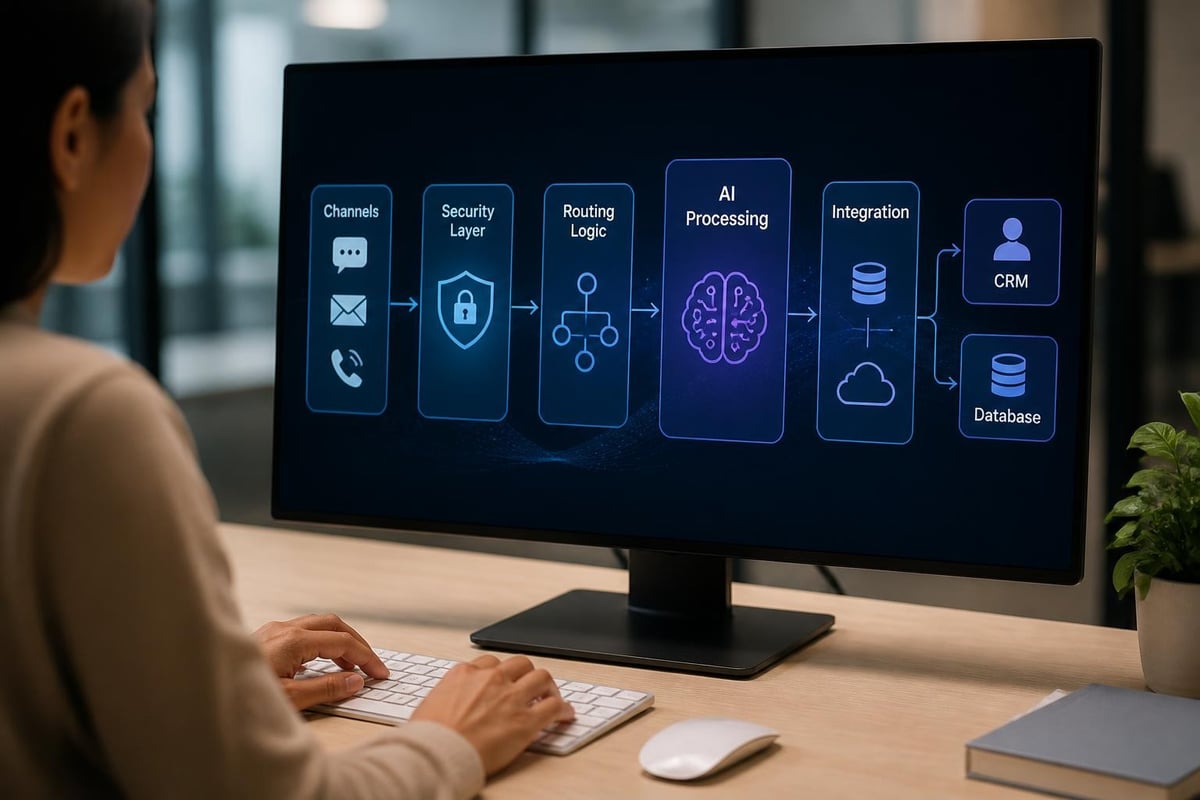
The foundation of effective ai channels includes several critical elements working in concert. Message routing ensures that incoming communications reach the appropriate AI agent based on content, urgency, and customer history. Protocol translation allows AI agents to speak the native language of each platform, whether that's REST APIs, webhooks, or proprietary messaging protocols.
State management keeps track of conversation progress across channels, preventing customers from having to repeat information when switching from email to chat. Authentication and security layers protect sensitive data while maintaining compliance with regulations like GDPR and CCPA.

Recent research into AI-mediated communication strategies reveals how businesses are leveraging these channels to guide customer interactions more effectively. The study highlights that organizations using multiple ai channels simultaneously see higher engagement rates and customer satisfaction scores compared to single-channel approaches.
Popular AI Channel Types for Business Operations
Different business functions require different communication approaches. Messenger integrations have become particularly valuable for customer-facing operations, while API-based channels excel at backend system integration.
Customer-Facing Channels
WhatsApp Business API dominates in regions where the platform has achieved market saturation, particularly in Europe, Latin America, and Asia. AI agents operating through WhatsApp can send order confirmations, shipping updates, and handle customer inquiries using rich media including images, documents, and location data.
Live chat widgets embedded on websites provide immediate assistance to visitors browsing products or services. These ai channels capture context about the pages customers are viewing, allowing agents to offer relevant suggestions and support without requiring customers to explain their situation.
Email channels remain critical for detailed communications, documentation, and formal correspondence. AI agents can process incoming emails, categorize requests, and generate appropriate responses while escalating complex issues to human team members.
Integration and System Channels
CRM connectors enable AI agents to read customer history, update records, and trigger workflows within systems like Salesforce, HubSpot, or amoCRM. This integration transforms AI agents from simple communicators into active participants in business processes.
Voice channels through VoIP systems and phone networks allow AI agents to handle incoming calls, make outbound calls for appointment reminders or follow-ups, and transfer calls to human agents when necessary. Research shows that voice communication remains crucial in AI-powered contact centers despite the growth of text-based channels.
| Channel Type | Best Use Cases | Average Response Time | Setup Complexity |
|---|---|---|---|
| Order updates, quick questions | 1-3 seconds | Medium | |
| Live Chat | Website support, sales | Instant | Low |
| Detailed inquiries, documentation | 2-5 minutes | Low | |
| Voice/Phone | Complex issues, personal touch | 5-10 seconds | High |
| SMS | Reminders, confirmations | 1-2 seconds | Low |
| CRM Integration | Data sync, workflow automation | Real-time | Medium-High |
Deploying Multi-Channel AI Strategies
Successfully implementing ai channels requires careful planning and phased rollouts. Organizations that rush deployment across all channels simultaneously often encounter integration conflicts and inconsistent customer experiences.
Channel Selection Framework
Begin by mapping your customer journey to identify critical touchpoints where AI assistance delivers maximum value. E-commerce businesses typically prioritize live chat for pre-purchase questions and email for post-purchase support. Service providers often focus on appointment scheduling channels and reminder systems.
Analyze your existing communication volume across platforms:
- Audit current customer contact methods and volumes
- Identify channels with longest response times or lowest satisfaction
- Evaluate technical requirements and integration complexity
- Prioritize based on business impact versus implementation effort
- Create a phased rollout schedule
The AI Textura platform simplifies this process by providing pre-built connectors to popular channels, eliminating much of the custom development traditionally required for multi-channel AI deployment.
Maintaining Consistency Across Channels
One of the biggest challenges with multiple ai channels involves ensuring consistent agent behavior regardless of communication method. An AI agent should provide the same accurate information whether customers reach out via Facebook Messenger, email, or phone.
Centralized knowledge bases serve as the single source of truth for all AI agents. When you update product information or policy details, the change propagates across all channels automatically. This approach prevents the frustrating scenario where customers receive conflicting information depending on their chosen contact method.
Unified conversation logs allow human team members to review interactions across all channels from a single interface. When a customer emails after a chat conversation, support staff can see the complete history without asking customers to repeat themselves.
Technical Implementation Considerations
The infrastructure supporting ai channels must balance performance, reliability, and cost-efficiency. Modern implementations typically employ cloud-native architectures that can scale dynamically based on conversation volume.
Message Queue Architecture
High-volume operations require robust message queuing systems that prevent lost communications during traffic spikes. When thousands of messages arrive simultaneously across various channels, queue systems ensure orderly processing without dropped conversations.
Priority routing within queues enables businesses to fast-track urgent messages, VIP customers, or high-value opportunities. A potential enterprise sale via chat might receive immediate AI agent attention while routine order status inquiries process in standard sequence.
Retry mechanisms automatically handle temporary failures when external services experience downtime. If a CRM system becomes unavailable, the ai channels queue messages and retry delivery once connectivity restores, preventing data loss.
Security and Compliance
Different channels present varying security challenges. Voice channels require encryption of audio streams and secure storage of call recordings. Messaging platforms must implement end-to-end encryption for sensitive information like payment details or medical data.
Authentication workflows verify customer identity before AI agents discuss account-specific information or perform actions like password resets. Multi-factor authentication integrations add additional security layers for high-risk operations.
Data residency controls ensure customer information stays within approved geographic regions, critical for GDPR compliance and other regional privacy regulations. AI channels must route data through compliant infrastructure based on customer location.
Performance Optimization for AI Channels
Channel performance directly impacts customer satisfaction and operational efficiency. Slow response times or frequent failures erode trust and drive customers toward competitors.
Latency Reduction Strategies
Geographic distribution of AI infrastructure places processing power closer to customers. A customer in Singapore connecting to servers in that region experiences significantly faster responses than routing traffic to distant data centers.
Caching mechanisms store frequently accessed information to eliminate repeated database queries. Product catalogs, pricing information, and common questions load from high-speed cache rather than origin systems.
Asynchronous processing handles time-consuming tasks in the background while AI agents continue conversations. When generating complex reports or processing large data sets, agents acknowledge requests immediately and deliver results when ready.
| Optimization Technique | Latency Improvement | Implementation Effort | Cost Impact |
|---|---|---|---|
| Geographic CDN | 40-60% reduction | Medium | Moderate increase |
| Redis Caching | 70-90% reduction | Low | Minimal increase |
| Message Queuing | Prevents timeouts | Medium | Minimal increase |
| Database Indexing | 30-50% reduction | Low | No change |
| Connection Pooling | 20-30% reduction | Low | Minimal decrease |
Monitoring and Analytics
Comprehensive monitoring across all ai channels reveals performance bottlenecks and improvement opportunities. Response time tracking identifies channels or agent types experiencing degraded performance. Error rate monitoring catches integration failures before they impact significant customer volumes.
Conversation analytics measure metrics beyond technical performance, including customer satisfaction, resolution rates, and conversion percentages. These insights guide decisions about channel investment and AI agent training priorities.
The AI Textura documentation provides detailed guidance on implementing monitoring dashboards and setting appropriate alerting thresholds for production environments.
Real-World Applications Across Industries
Different industries leverage ai channels in unique ways based on their specific operational requirements and customer expectations.
Hospitality Sector
Hotels and resorts deploy ai channels for reservation management, guest services, and post-stay follow-up. WhatsApp channels handle pre-arrival questions about amenities and local attractions. Voice channels manage reservation changes and special requests. Email channels send personalized pre-arrival information and post-stay surveys.
AI agents access property management systems through API channels to check room availability, process bookings, and update guest preferences. This integration enables real-time inventory management across all booking channels without manual intervention.
E-Commerce Operations
Online retailers use ai channels throughout the customer lifecycle. Live chat channels assist shoppers with product selection and sizing questions. Email channels handle order confirmations, shipping notifications, and return authorizations. SMS channels send delivery updates and collect feedback.
Integration channels connect AI agents to inventory systems, payment processors, and logistics providers. When customers ask about order status, agents retrieve real-time tracking information rather than generic responses. When products go out of stock, agents can automatically suggest alternatives based on customer preferences.

Professional Services
Consulting firms, law offices, and accounting practices leverage ai channels for appointment scheduling, client communication, and document management. Calendar integration channels prevent double-booking and automatically send meeting reminders. Document channels extract information from uploaded files and route them to appropriate team members.
These organizations particularly value channels that maintain professional communication standards while operating efficiently. The ability to compare different AI solutions helps professional services firms select platforms matching their specific requirements for client interaction quality.
Future Trends in AI Channel Development
The landscape of ai channels continues evolving rapidly as new communication platforms emerge and existing channels add capabilities. Several trends are reshaping how businesses think about AI-powered communication.
Emerging Channel Types
Augmented reality channels enable AI agents to guide customers through visual experiences, particularly valuable for furniture placement, home improvement, and technical support. Customers point their device cameras at spaces or products while AI agents overlay information and instructions.
IoT device channels connect AI agents to smart home systems, industrial equipment, and wearable devices. These channels enable proactive support where AI agents detect issues and reach out to customers before problems escalate.
Blockchain-based channels provide verifiable audit trails for regulated industries requiring proof of customer consent, transaction history, or compliance documentation. Financial services and healthcare organizations are exploring these channels for sensitive communications.
YouTube's recent efforts to combat low-quality AI-generated content highlight the importance of maintaining quality standards as AI becomes more prevalent across communication channels.
Channel Intelligence Evolution
Next-generation ai channels incorporate advanced capabilities beyond simple message routing. Sentiment analysis across channels identifies frustrated customers requiring immediate human intervention. Intent prediction routes conversations to specialized agents based on detected customer goals.
Cross-channel learning allows AI agents to improve performance on one channel based on successful interactions on others. Effective email responses inform chat conversation strategies, and voice channel successes enhance messaging approaches.
Integration Best Practices
Successful ai channels implementation requires attention to both technical and organizational factors. Companies that treat channel deployment as purely technical projects often struggle with adoption and effectiveness.
Organizational Alignment
Cross-functional teams including IT, customer service, sales, and marketing ensure ai channels meet diverse stakeholder needs. Customer service teams provide insights into common pain points and conversation patterns. Sales teams identify opportunities for AI-assisted lead qualification and nurturing.
Gradual capability expansion prevents overwhelming customers and staff with too many changes simultaneously. Start with basic question-answering capabilities on a single channel, then progressively add transaction capabilities and additional channels based on performance data.
Change management processes prepare employees for shifting roles as AI agents handle routine tasks. Staff transition from answering basic questions to managing complex issues and improving AI agent performance through feedback and training.
Training and Knowledge Management
Effective ai channels require comprehensive, well-organized knowledge that agents can access and understand. Structured documentation using consistent formats enables AI agents to extract relevant information quickly and accurately.
Regular content updates keep AI agent responses current as products, policies, and procedures change. Automated alerts notify knowledge managers when AI agents struggle to answer specific question types, indicating gaps requiring new content.
Version control tracks knowledge base changes over time, enabling rollback when updates cause unexpected AI agent behavior. This practice proves particularly valuable when troubleshooting sudden drops in conversation quality or accuracy.
Platforms offering robust knowledge management capabilities simplify the ongoing maintenance required for high-performing AI channels.
Implementing effective ai channels transforms how businesses operate, enabling scalable customer communication without proportional increases in staffing costs. The key lies in selecting appropriate channels for your specific business model, maintaining consistency across touchpoints, and continuously optimizing based on performance data. AI Textura provides the infrastructure and tools necessary to deploy AI agents across multiple channels without managing complex server configurations or writing custom integration code, letting you focus on delivering exceptional customer experiences while your AI workforce handles operations in over 90 languages.