

The intersection of ai and business has evolved from experimental technology into a fundamental operational requirement. Companies across industries now face a critical decision: adapt their business models to leverage intelligent automation or risk falling behind competitors who are already reaping the benefits. The transformation extends beyond simple chatbots and basic automation, encompassing comprehensive systems that handle complex business operations with minimal human intervention. As we progress through 2026, understanding how to effectively implement AI solutions has become essential for maintaining competitive advantage and operational efficiency.
Understanding the Current AI and Business Landscape
The relationship between ai and business has matured significantly over the past few years. Organizations are no longer asking whether to adopt AI, but rather how to deploy it most effectively across their operations. Artificial intelligence technologies are transforming business operations through machine learning, natural language processing, and automated decision-making systems that operate 24/7 without traditional workforce limitations.
Modern AI applications extend far beyond the narrow tools of previous years. Today's intelligent systems can manage entire business functions, from customer acquisition to post-sale support, operating independently while maintaining brand consistency and quality standards. This shift represents a fundamental change in how companies structure their operations and allocate resources.
The Evolution of Business Automation
Traditional automation focused on repetitive, rule-based tasks. Contemporary AI systems handle nuanced decision-making, customer interactions, and strategic operations. The difference lies in their ability to learn, adapt, and improve performance over time without constant reprogramming.
Key capabilities transforming business operations:
- Natural language understanding in over 90 languages
- Real-time decision-making based on contextual data
- Integration with existing business systems and CRM platforms
- Autonomous task execution including bookings, sales, and updates
- Continuous learning from customer interactions and outcomes
Companies implementing these advanced systems report significant improvements in response times, customer satisfaction, and operational costs. When comparing AI agents to traditional hiring, businesses discover substantial advantages in scalability, consistency, and cost efficiency.
Strategic Implementation of AI Workforce Solutions
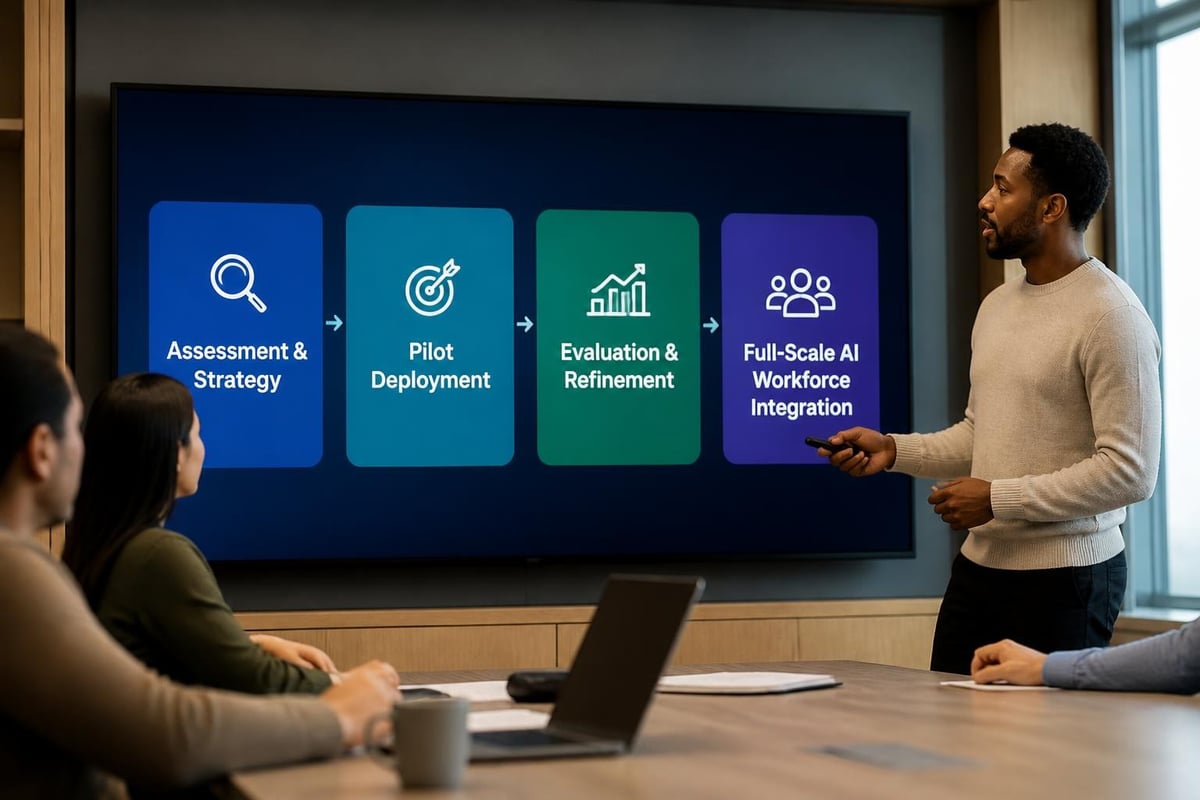
Deploying ai and business integration successfully requires careful planning and strategic alignment. Organizations must move beyond pilot projects and isolated use cases to create comprehensive AI strategies that support overall business objectives.
Building Your AI Strategy
The foundation of successful AI implementation starts with clear objectives and measurable outcomes. Building a successful AI strategy requires aligning technology initiatives with specific business goals rather than adopting technology for its own sake.
Critical steps for strategic deployment:
- Assess current operations to identify high-impact automation opportunities
- Define success metrics that align with revenue, efficiency, or customer satisfaction goals
- Select appropriate platforms that integrate with existing systems without requiring extensive technical expertise
- Pilot in controlled environments before scaling across the organization
- Monitor and optimize based on performance data and business outcomes
Many organizations struggle with the gap between AI insights and execution. Moving beyond the chat phase requires integrating AI into actual business workflows where it can drive measurable results rather than simply providing recommendations.
Selecting the Right AI Platform
The platform choice determines implementation complexity, scalability potential, and long-term success. Businesses should prioritize solutions that offer genuine autonomy rather than requiring constant technical oversight.
| Evaluation Criteria | Traditional Solutions | Modern AI Platforms |
|---|---|---|
| Technical Requirements | Coding, server management, IT teams | No-code, cloud-hosted, user-friendly |
| Deployment Time | Months of development | Days to weeks |
| Language Support | Limited, requires translation services | 90+ languages natively |
| Integration Capability | Custom API development | Pre-built connectors |
| Scalability | Resource-intensive | Instant scaling |
Organizations benefit from platforms that host AI agents capable of taking real actions across business operations without requiring server management or coding expertise.
Practical Applications Across Business Functions
The versatility of ai and business integration becomes apparent when examining specific departmental applications. Intelligent agents now handle complex tasks across every business function, delivering consistent results regardless of volume or time zone.
Sales and Revenue Generation
AI agents manage the entire sales pipeline from initial contact through closing and follow-up. These systems qualify leads, schedule demonstrations, answer product questions, and process transactions autonomously. They maintain perfect CRM hygiene by automatically updating records and tracking customer interactions.
Sales teams report that AI handles 70-80% of routine inquiries, allowing human representatives to focus on high-value relationships and complex negotiations. The result is faster response times, higher conversion rates, and improved customer experience.
Customer Support and Service
Support operations represent one of the highest-impact areas for ai and business integration. Intelligent agents resolve common issues instantly, escalate complex problems appropriately, and maintain detailed interaction histories across all communication channels.
Benefits realized in customer support:
- 24/7 availability across all time zones
- Instant response to customer inquiries
- Consistent quality regardless of volume
- Seamless handoff to human agents when needed
- Comprehensive interaction tracking and analytics
The hospitality industry has particularly benefited from AI support systems, with hotels using intelligent agents to handle reservations, answer guest questions, and manage special requests in multiple languages simultaneously.

Marketing and Lead Nurturing
Marketing automation powered by AI goes beyond scheduled emails and basic segmentation. Modern systems analyze customer behavior, personalize messaging in real-time, and adjust campaigns based on performance data without manual intervention.
AI agents engage prospects through their preferred channels, qualify interest levels, and deliver targeted content that matches each stage of the buyer journey. This personalization happens at scale, treating each prospect as an individual while maintaining consistency with overall brand messaging.
Human Resources and Internal Operations
HR departments leverage ai and business integration for recruitment, onboarding, employee support, and administrative tasks. AI agents screen applications, schedule interviews, answer policy questions, and process routine requests that traditionally consumed significant HR team time.
Internal operations benefit from AI handling document processing, data entry, system updates, and interdepartmental coordination. These behind-the-scenes improvements compound over time, freeing knowledge workers to focus on strategic initiatives rather than administrative overhead.
Measuring ROI and Business Impact
Successful ai and business implementation requires rigorous measurement and continuous optimization. Organizations must track both quantitative metrics and qualitative improvements to understand true impact.
Key Performance Indicators
Effective measurement combines operational efficiency metrics with business outcome data. AI implications for business strategy include fundamental changes in how companies make decisions and compete in their markets.
| Metric Category | Example Measurements | Typical Improvements |
|---|---|---|
| Efficiency | Response time, resolution rate, handling capacity | 60-80% reduction in response time |
| Cost | Per-interaction cost, staffing requirements | 40-70% lower operational costs |
| Revenue | Conversion rate, average deal size, sales cycle length | 20-40% increase in conversions |
| Quality | Customer satisfaction, accuracy, consistency | 15-30% higher satisfaction scores |
| Scalability | Volume capacity, seasonal handling | Unlimited scaling without additional cost |
The most successful implementations track these metrics continuously and use the data to refine AI agent behavior and expand automation scope.
From Pilot to Production
Many organizations struggle with scaling AI from successful pilots to enterprise-wide deployment. Turning AI projects into production results requires trusted data, governed workflows, and appropriate human oversight.
The transition involves several critical phases:
- Validation: Confirm pilot results represent actual business impact, not just technical success
- Integration: Connect AI systems deeply with existing business processes and data sources
- Training: Ensure teams understand how to work alongside AI agents effectively
- Expansion: Gradually extend AI capabilities to additional functions and use cases
- Optimization: Continuously refine based on performance data and changing business needs
Organizations that rush deployment without proper validation and integration often experience disappointing results despite strong pilot performance.
Industry-Specific Applications and Case Studies
Different industries face unique challenges that ai and business integration addresses in specialized ways. Understanding these sector-specific applications helps organizations identify relevant use cases for their context.
Hospitality and Tourism
Hotels, resorts, and travel companies leverage AI agents for reservation management, guest communication, and service coordination. These systems handle booking modifications, answer property questions, coordinate special requests, and manage check-in processes across multiple languages and time zones.
The multilingual capability proves particularly valuable in international markets, where a single AI agent can communicate fluently with guests from dozens of countries without requiring human translators or multilingual staff.
E-commerce and Retail
Online retailers deploy AI across the customer journey, from product discovery through post-purchase support. Intelligent agents recommend products, answer specification questions, process orders, track shipments, and handle returns with minimal human intervention.
The consistency of AI interactions ensures every customer receives the same high-quality experience regardless of when they shop or which channel they use to communicate.

Professional Services
Consulting firms, agencies, and service providers use AI for client intake, project coordination, scheduling, and routine client communication. This automation allows professional teams to focus on high-value strategic work while AI handles administrative coordination.
The impact on utilization rates can be substantial, with firms reporting 15-25% increases in billable hours as professionals spend less time on coordination and more time on client deliverables.
Overcoming Common Implementation Challenges
While the benefits of ai and business integration are substantial, organizations face predictable challenges during implementation. Understanding these obstacles in advance enables proactive mitigation strategies.
Technical Integration Complexity
Legacy systems and fragmented data sources complicate AI deployment. The solution lies in selecting platforms with robust integration capabilities and pre-built connectors for common business systems. AI in business applications increasingly emphasize ease of integration as a critical success factor.
Organizations should prioritize solutions that work with existing infrastructure rather than requiring wholesale system replacement. The best platforms connect seamlessly with CRM systems, communication channels, and business databases through standardized interfaces.
Change Management and Adoption
Employee resistance to AI adoption stems from job security concerns and comfort with existing processes. Successful implementations address these concerns directly through transparent communication about AI's role in augmenting rather than replacing human workers.
Strategies for successful adoption:
- Clearly communicate which tasks AI will handle and which remain human responsibilities
- Provide hands-on training showing how AI makes employees' jobs easier
- Start with pain points that employees want to eliminate
- Share early wins and celebrate improvements
- Involve employees in refining AI behavior and expanding capabilities
Teams that work alongside AI agents typically report higher job satisfaction as they shed repetitive tasks and focus on more engaging work.
Data Quality and Governance
AI systems require clean, accurate data to function effectively. Organizations must establish data governance practices that ensure AI agents access current, reliable information. This includes regular data audits, clear ownership of data quality, and processes for keeping knowledge bases updated.
The investment in data quality pays dividends beyond AI performance, improving overall business intelligence and decision-making across the organization.
Future Trends in AI and Business Integration
The trajectory of ai and business evolution points toward increasingly autonomous, capable systems that handle progressively complex business operations. AI's impact on business strategy continues expanding as technology capabilities advance and organizations develop sophistication in deployment approaches.
Autonomous Business Operations
The next frontier involves AI systems that manage entire business processes end-to-end with minimal human oversight. These systems will coordinate across functions, make strategic decisions within defined parameters, and continuously optimize operations based on outcome data.
Early adopters are already deploying AI that handles complete customer lifecycles, from acquisition through retention, with human teams focusing on strategic direction and exceptional cases.
Hyper-Personalization at Scale
Advances in AI enable personalization that was previously impossible at scale. Each customer interaction adapts in real-time based on individual preferences, behavior patterns, and contextual signals. This level of customization creates competitive advantages in customer experience and conversion rates.
Cross-Functional AI Orchestration
Rather than isolated AI agents for specific functions, organizations are deploying orchestrated systems where multiple AI agents collaborate across departments. A customer inquiry might involve sales, support, and operations agents working together seamlessly to deliver comprehensive solutions.
This orchestration mirrors how high-performing human teams collaborate, but operates at machine speed and scale.
Building Competitive Advantage Through AI
Organizations that excel at ai and business integration create sustainable competitive advantages. How AI technologies redefine competitive advantage in the digital era centers on organizational transformation and strategic decision-making capabilities that AI enables.
The advantages compound over time as AI systems learn from interactions, accumulate knowledge, and improve performance. Companies that start earlier build larger knowledge bases and more refined systems, creating barriers to competition that grow stronger rather than weaker over time.
Cost Leadership Through Efficiency
AI-powered operations achieve cost structures that traditional models cannot match. The ability to handle unlimited volume without proportional cost increases creates fundamental economic advantages. Organizations can serve more customers, enter new markets, and offer competitive pricing while maintaining healthy margins.
Service Differentiation
Companies using AI deliver response times and availability that set new customer expectations. The 24/7, multilingual, instant-response standard becomes a baseline rather than a premium offering. Organizations that cannot match this standard face increasing competitive pressure.
Operational Flexibility
AI workforces scale instantly to meet demand fluctuations without the lag time, risk, and cost of traditional hiring. This flexibility enables organizations to pursue opportunities that would be too risky or capital-intensive with conventional staffing approaches.
Seasonal businesses particularly benefit, handling peak periods effortlessly without maintaining expensive overhead during slower periods.
AI and business integration has transitioned from competitive advantage to operational necessity across industries. Organizations that implement intelligent automation strategically position themselves for sustainable growth while those that delay face increasing pressure from more efficient competitors. AI Textura provides businesses with a comprehensive platform for deploying AI agents that manage sales, support, marketing, and HR operations without coding or server management, enabling companies to realize these benefits quickly and scale operations across 90+ languages while maintaining full control over their automated workforce.